
Dasysyrphus
Enderlein, 1938
Species Guides
8- Dasysyrphus creper(Arched Brusheye)
- Dasysyrphus intrudens(intrudens complex)
- Dasysyrphus laticaudus(Boreal Brusheye)
- Dasysyrphus limatus(Narrow-banded Brusheye)
- Dasysyrphus occidualis(Western Brusheye)
- Dasysyrphus pacificus
- Dasysyrphus pauxillus(Lesser Brusheye)
- Dasysyrphus venustus
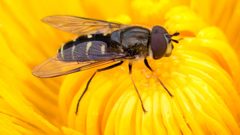
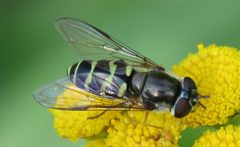
Dasysyrphus is a of hoverflies (Syrphidae) comprising approximately 50 described distributed worldwide. The genus is relatively straightforward to identify, though species-level differentiation requires careful examination and should not rely solely on images. are medium-sized with distinctive morphological features including hairy and microtrichose wings. Larvae are primarily arboreal, feeding nocturnally on aphids and other small Hemiptera.
Pronunciation
How to pronounce Dasysyrphus: /ˈdæsɪˌsɪrfəs/
These audio files are automatically generated. While they are not always 100% accurate, they are a good starting point.
Identification
Distinguished from other hoverfly by the combination of hairy , elongate wing stigma, and microtrichose wing covering. identification requires examination of subtle morphological differences and should utilize available regional keys rather than images alone. D. albostriatus can be recognized by downward-angled yellow abdominal bars forming an inverted 'V' and grey thoracic stripes; D. tricinctus by its triple abdominal banding pattern.
Images
Appearance
Medium-sized hoverflies with hairy and microtrichose wings covering at least the third. Wing third ends at the apex. Elongate black wing stigma present. Calypter with bare lobe. Metasternum bare. with grooved margin, dark with light spots on tergites 2, 3, and 4. Specific patterns vary by : D. albostriatus has yellow bars on abdominal segments 2-4 angled downward, often into an inverted 'V', plus grey thoracic stripes; D. tricinctus displays a distinctive triple abdominal marking pattern.
Habitat
Woodland clearings and edges; broadleaf and coniferous woodlands; heathlands. Larvae inhabit trees, occurring on both conifers and deciduous .
Distribution
Worldwide distribution including Palearctic, Nearctic, and other regions. Documented from Great Britain and Ireland throughout the Palearctic, extending to Iran (Northern Iran records for D. albostriatus and D. tricinctus). North American records include Vermont and other US localities. Nordic countries, Urals, Siberia, Far East, Northwestern Europe, Russia, and India represented in -level documentation.
Seasonality
activity varies by and region. D. albostriatus with periods April-June and August-September. D. tricinctus active March-October with peaks in late May-early June and late August-early September in Ireland.
Diet
Larvae are aphidophagous, feeding on arboreal and other small Hemiptera. D. tricinctus larvae have been observed consuming lepidopterous caterpillars and larvae. visit wide range of flowers; D. tricinctus shows preference for yellow flowers such as buttercups and dandelions.
Host Associations
- arboreal aphid species - preyprimary larval food source
- Acer pseudoplatanus (sycamore) - D. tricinctus association
Life Cycle
in documented , with two per year. Larval development occurs in arboreal .
Behavior
Larvae are feeders, resting during daytime near colonies. Camouflage : larvae use dark coloration and body projections to blend with twigs and bark. flower visitation occurs in both sexes.
Ecological Role
Predatory larvae contribute to of arboreal . serve as through flower visitation.
Human Relevance
Potential value in of tree-dwelling pests. Subject of taxonomic and genomic research; chromosomally complete sequences available for D. albostriatus (662.5 Mb) and D. tricinctus (1,054.90 Mb).
Similar Taxa
- Other Syrphinae generaDasysyrphus distinguished by hairy and elongate wing stigma combination; other lack this specific character set
- Dasysyrphus congeners-level identification requires morphological examination and regional keys due to narrow range of interspecific variation
More Details
Identification Resources
Regional keys available: Bartsch et al. (2009) Nordic countries; Barkalov (2007) Urals, Siberia, Far East; van Veen (2004) Northwestern Europe; Van der Goot (1981) Russia; Stubbs & Falk (1983) Britain; Ghorpade (1994) India; Peck (1974) Palaearctic; Locke (2013) Nearctic.
Genomic Resources
Chromosomally complete assemblies generated for D. albostriatus (female, Oxfordshire UK, 5 chromosomal pseudomolecules including X , 12,259 protein-coding genes) and D. tricinctus (male, Wytham Woods Oxfordshire UK, 5 chromosomal pseudomolecules, XO sex determination system inferred).
Sources and further reading
- BugGuide
- Wikipedia
- GBIF taxonomy match
- iNaturalist taxon
- NCBI Taxonomy
- Catalogue of Life
- First record of Dasysyrphus tricinctus (Fallén, 1817) (Diptera: Syrphidae) from Iran
- The genome sequence of the yellow-girdled Dasysyrphus, Dasysyrphus tricinctus (Fallén, 1817).
- The genome sequence of the Stripe-backed Dasysyrphus, Dasysyrphus albostriatus (Fallén, 1817).