
Dasysyrphus venustus
(Meigen, 1822)
Dasysyrphus venustus is a Holarctic hoverfly (Diptera: Syrphidae) distributed across the Palaearctic region from Fennoscandia to the Pacific coast. It is the most frequent and widely distributed in its , though studies indicate it may represent a complex of cryptic species due to high morphological and genetic variability. are active primarily in spring, with a period from April to June.
Pronunciation
How to pronounce Dasysyrphus venustus: //ˌdeɪsɪˈsɪrfəs vɪˈnʌstəs//
These audio files are automatically generated. While they are not always 100% accurate, they are a good starting point.
Identification
Distinguished from similar Dasysyrphus by the consistent presence of a pale pattern on tergite 2 that equals or exceeds the width of patterns on tergites 3 and 4, combined with the black facial stripe. The equal-sized yellow patterns on tergites 3 and 4 separate it from species with asymmetric or differently proportioned markings. Male genitalia require examination for definitive identification.
Images
Appearance
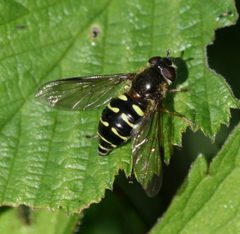
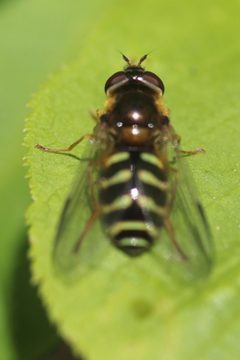
Medium-sized hoverfly with wing length 6.25–10 mm. are hairy. with characteristic yellow patterning: tergite 2 always has a pale pattern that is as broad as or broader than the patterns on tergites 3 and 4; tergites 3 and 4 bear equal-sized yellow patterns. has a black longitudinal stripe. Female with sternite 2 black at hind margin and faint dust spots on .
Habitat
Deciduous and coniferous woodlands including Fagus, Quercus, and Betula forests, alluvial deciduous forests, and Pinus, Picea, and Abies forests. Found in clearings, tracksides, and arboreal , descending to visit flowers.
Distribution
Palaearctic distribution spanning Fennoscandia south to Northern Spain, Ireland eastward through North and Central Europe including Italian and Yugoslavian mountains, continuing through European and Russian Far East and Siberia to the Pacific coast including the Kuril Islands. Records confirmed from Belgium (Flanders, Brussels-Capital Region, Walloon Region).
Seasonality
period April to June; activity extends later at higher altitudes and more northerly latitudes.
Diet
feed on nectar and pollen of diverse flowering plants including white Umbelliferae, Acer platanoides, Acer pseudoplatanus, Allium ursinum, Berberis, Caltha, Crataegus, Endymion, Euphorbia, Frangula alnus, Ilex, Lonicera xylosteum, Potentilla erecta, Prunus cerasus, Prunus spinosa, Ranunculus, Rubus idaeus, Salix, Sambucus, Sorbus aucuparia, Stellaria, and Taraxacum. Larval diet unknown.
Life Cycle
Larva figured by Dusek and Laska (1962); detailed information not documented. Developmental stages include , larva, pupa, and typical of Diptera, but specific duration and requirements for stages are not established.
Behavior
Arboreal habits with regular descent to visit flowers. Has been observed visiting a broad spectrum of flowering plants across multiple .
Ecological Role
function as through nectar and pollen feeding. Larval unknown; related syrphid larvae are often predatory on aphids or saprophagous, but this has not been confirmed for D. venustus.
Human Relevance
No documented direct economic or medical importance. Potential value as in forest .
Similar Taxa
- Other Dasysyrphus speciesShare general body plan and yellow-black coloration; distinguished by abdominal pattern details, particularly the consistent presence and width of tergite 2 pale pattern relative to tergites 3 and 4, and facial stripe characteristics.
More Details
Taxonomic Complexity
Studies indicate very high morphological and genetic variability in D. venustus, suggesting it represents a rather than a single biological .
Holarctic Distribution
Described as Holarctic in primary literature, though detailed Nearctic records require verification given the primarily Palaearctic distribution documented in recent sources.