
Chalcosyrphus plesia
(Curran, 1925)
Black-hipped Leafwalker
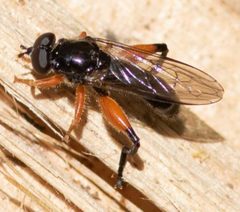
Chalcosyrphus plesia, known as the black-hipped leafwalker, is an uncommon syrphid fly found in the northeastern United States and southeastern Canada. The is a documented mimic of the digger wasp Sphex nudus. Unlike many syrphids that hover at flowers, this species exhibits behavioral and morphological adaptations associated with dead wood . The specific epithet "plesia" and "black-hipped leafwalker" refer to distinctive dark coloration on the body region.
Pronunciation
How to pronounce Chalcosyrphus plesia: //ˌkælkoʊˈsɪrfəs ˈplɪziə//
These audio files are automatically generated. While they are not always 100% accurate, they are a good starting point.
Identification
Distinguished from by all-black coloration without steel blue highlights (C. chalybeus) or red abdominal markings (C. piger). The enlarged, ventrally toothed metafemora are distinctive but shared with other Chalcosyrphus ; combined with the black coloration and in males, these features support identification. The species is most reliably separated from the similar Xylota by subtle morphological details requiring microscopic examination.
Images
Appearance
are predominantly black in coloration, lacking the steel blue highlights seen in the related C. chalybeus and the red abdominal markings characteristic of C. piger. The possesses distinctly enlarged, ventrally spinose metafemora (hind ) with correspondingly curved tibiae. Males exhibit (contiguous) . The overall body form is relatively large and robust compared to many flower-visiting syrphids, with a hulking, compact build adapted for moving on woody substrates.
Habitat
Associated with dead and decaying wood, including recently fallen or wind-thrown trees. are found on tree trunks and logs, particularly of hardwood such as hickory (Carya). The species shows strong fidelity to woody substrates rather than flowers.
Distribution
Northeastern United States and southeastern Canada. Specific documented locations include Missouri (Sam A. Baker State Park) and presumably other states within the northeastern North American region.
Diet
feed on pollen. Larvae are saprophages that develop in decaying wood.
Host Associations
- Carya alba - Mockernut hickory; observed on trunks of recently wind-thrown trees
Life Cycle
Larvae develop in decaying wood, feeding on decomposing wood material and possibly fermenting sap. occurs within the wood substrate. emerge and are active during warmer months.
Behavior
repeatedly return to and land on dead wood trunks when disturbed, showing strong site fidelity to woody substrates. The enlarged metafemora with spines and curved tibiae suggest adaptations for gripping bark surfaces or possibly predatory functions, though this remains unconfirmed. The does not exhibit the hovering typical of many syrphid flies at flowers.
Ecological Role
Larvae contribute to wood decomposition as saprophages. serve as when feeding on pollen, though they are less flower-associated than most syrphids. The participates in mimicry complexes as a Batesian mimic of stinging (Sphex nudus), potentially reducing pressure.
Similar Taxa
- Chalcosyrphus chalybeusSimilar size and build, but exhibits distinctive steel blue highlights on the body; C. plesia lacks this coloration and is entirely black
- Chalcosyrphus pigerSimilar overall and preferences, but consistently shows red abdominal markings; C. plesia has entirely black
- Xylota spp.Related with similar wood-associated habits and ; distinguished by subtle structural features of the and legs requiring microscopic examination
More Details
Taxonomic history
Originally described as Xylota plesia by Curran in 1925, later transferred to Chalcosyrphus. The belongs to the subgenus Xylotomima within Chalcosyrphus.
Mimicry system
A documented mimic of Sphex nudus, a digger wasp ( Sphecidae). This represents a shift from the typical yellowjacket-mimicry common in many syrphid flies to mimicry of solitary , matching the ' and preferences.