
Chalcosyrphus chalybeus
(Wiedemann, 1830)
violet leafwalker
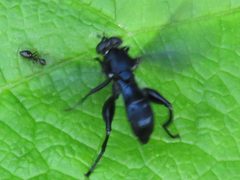
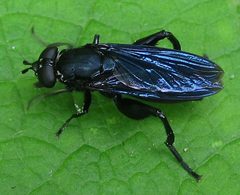
Chalcosyrphus chalybeus, commonly known as the violet leafwalker, is a of syrphid fly (flower fly) found in the northeastern United States and adjacent Canada. are characterized by their all-black coloration with a distinctive steely blue or violet metallic sheen. Unlike many syrphid flies, this species shows a strong association with dead wood rather than flowers. The larvae develop in decaying wood as saprophages, while adults are known to visit flowers for nectar and pollen. Males possess (contiguous) , a trait unusual among syrphid flies.
Pronunciation
How to pronounce Chalcosyrphus chalybeus: //kal.koˈsɪɹ.fəs kaˈlɪ.bi.us//
These audio files are automatically generated. While they are not always 100% accurate, they are a good starting point.
Identification
are entirely black with a distinctive steely blue to violet metallic sheen, distinguishing them from the similar Chalcosyrphus piger which has red abdominal markings. Males are identifiable by their (contiguous) , where the eyes meet at the top of the ; females have separated eyes. The has enlarged, ventrally spinose metafemora (hind ) with correspondingly curved tibiae—a distinctive modification whose function remains unclear but may relate to mating or substrate gripping on wood. The all-black coloration without red markings separates it from C. piger, while the metallic blue sheen distinguishes it from other all-black Chalcosyrphus and Xylota species.
Images
Habitat
Associated with forested areas containing dead and decaying wood. frequently encountered on trunks of recently dead or wind-thrown trees, particularly hickory (Carya spp.) and other hardwoods. Also found in woodland edges and openings where flowers are available.
Distribution
Northeastern United States and adjacent Canada. Documented from Vermont and broadly across the northeastern U.S.
Seasonality
active during summer months, with observations typically from late spring through summer.
Diet
Larvae are saprophages, feeding on decaying wood. feed on nectar and pollen from flowers.
Life Cycle
Complete with four stages: , larva, pupa, and . Larvae develop within decaying wood, feeding as saprophages on decomposing plant material. occurs within the wood substrate. Adults emerge and are active during summer, with males exhibiting .
Behavior
show strong fidelity to dead wood substrates, repeatedly returning to and landing on dead tree trunks when disturbed. This reflects their larval association with decaying wood. Adults also visit flowers for feeding. Males possess contiguous , suggesting visual-based mate location. The enlarged hind with spines and curved tibiae are distinctive but their behavioral function has not been documented in the literature.
Ecological Role
Larvae contribute to wood decomposition as saprophages in forest . may serve as when visiting flowers for nectar and pollen. The occupies a distinctive among syrphid flies due to its wood-associated rather than strictly flower-associated adult .
Human Relevance
Of minor direct human relevance. Not known to be a pest or beneficial in agricultural or forestry contexts. May be encountered by entomologists and naturalists investigating dead wood fauna.
Similar Taxa
- Chalcosyrphus pigerSimilar size and body form, but C. piger has red abdominal markings which C. chalybeus lacks
- Xylota speciesRelated with similar wood-associated habits, but different 'gestalt' and lack the distinctive steely blue metallic sheen of C. chalybeus
- Chalcosyrphus chalybea (sensu stricto)The name 'chalybea' has been applied to various ; C. chalybeus specifically refers to the steely blue-black northeastern form without red markings