
Chalcosyrphus piger
(Fabricius, 1794)
Short-haired Leafwalker
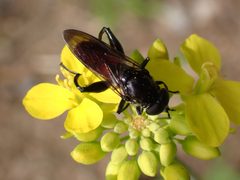
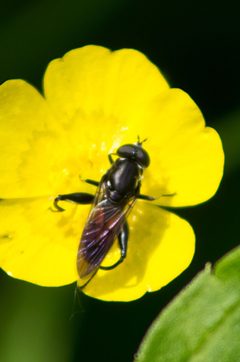
Chalcosyrphus piger is a of hoverfly ( Syrphidae) found across North America and Europe. are commonly known as flower flies and are frequently observed around flowers where they obtain nectar and pollen. The species is considered uncommon and is distinguished from by its characteristic red abdominal markings. Larvae develop in decaying wood, specifically in sappy hollows of Larix and Pinus trees.
Pronunciation
How to pronounce Chalcosyrphus piger: //kælkoʊˈsɪrfəs ˈpaɪɡər//
These audio files are automatically generated. While they are not always 100% accurate, they are a good starting point.
Identification
Distinguished from Chalcosyrphus chalybeus by red abdominal markings (C. chalybeus is all-black without red). Separated from C. chalybea by lack of steel-blue highlights. The enlarged, ventrally spinose metafemora are distinctive but require close examination. The combination of black body with red abdominal markings, robust build, and association with dead wood distinguishes this from other syrphid like Xylota.
Images
Appearance
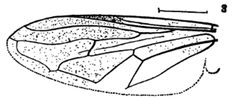
are robust, hulking flies with predominantly black coloration. The features distinctive red markings, separating it from the all-black C. chalybeus and the steel-blue C. chalybea. Males exhibit (contiguous) . The metafemora are enlarged and ventrally spinose, with correspondingly curved tibiae. Wing venation includes a characteristic spurious typical of Syrphidae.
Habitat
Associated with forested areas containing dead and decaying wood. frequent flowers in woodland and edge . Larval habitat is specifically sappy hollows in Larix (larch) and Pinus (pine) trees.
Distribution
Transcontinental distribution spanning Europe and North America. Present in Belgium (including Brussels-Capital, Flemish, and Walloon regions), Denmark, Canada, and the United States. The is considered uncommon throughout its range.
Diet
feed on nectar and pollen from flowers. Larvae are saprophagous, consuming decaying wood and associated microorganisms in sappy hollows of coniferous trees.
Host Associations
- Larix - larval larvae develop in sappy hollows
- Pinus - larval larvae develop in sappy hollows
Life Cycle
Complete with , larva, pupa, and stages. Larvae develop in decaying wood of coniferous trees, particularly in sappy hollows. Adults emerge and are active during warmer months, with females observed ovipositing on freshly cut or decaying pine logs.
Behavior
exhibit typical hoverfly , hovering motionless in and frequently visiting flowers. Females have been observed landing on logs to oviposit. The shows strong association with dead wood, with adults repeatedly returning to and landing on trunks of dead trees when disturbed. Some individuals may flick wings while running on foliage or log surfaces, mimicking behavior.
Ecological Role
contribute to pollination through flower visitation. Larval saprophagy contributes to wood decomposition and nutrient cycling in forest . The serves as a component of the diverse insect associated with dead wood .
Human Relevance
Of minor direct importance to humans. may be encountered by entomologists and naturalists in forested areas. The is not considered a pest; larval development in dead wood does not impact living trees.
Similar Taxa
- Chalcosyrphus chalybeusSimilar robust black body form, but C. chalybeus lacks red abdominal markings and is all-black
- Chalcosyrphus chalybeaSimilar body form, but C. chalybea exhibits distinctive steel-blue highlights not present in C. piger
- Xylota spp.Related with similar dead wood associations, but differing in gestalt and morphological details
Misconceptions
Larvae were historically presumed to be predatory like some related groups, but are now known to be saprophagous rather than of wood-boring larvae.
More Details
Taxonomic History
Originally described as Syrphus piger by Fabricius in 1794, later transferred to Chalcosyrphus. The has been subject to taxonomic confusion with related all-black or steel-blue .
Morphological Specializations
The enlarged, ventrally spinose metafemora with curved tibiae represent distinctive morphological features whose precise functional significance remains unclear, though they may assist in gripping wood surfaces or play a role in male-male interactions.