
Spilomyia texana
Johnson, 1921
Texas Hornet Fly
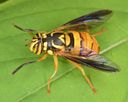
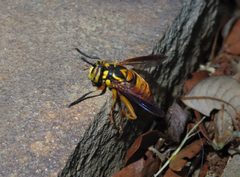
Spilomyia texana is a hover fly ( Syrphidae) first described from Texas in 1921 by Johnson. The is currently treated as a synonym of Spilomyia alcimus (Walker, 1849), the Broad-banded Hornet Fly, by major taxonomic databases including GBIF and Catalogue of Life. Like other members of the Spilomyia, it is a mimic with yellow and black coloration. The genus contains approximately 13 species in North America, all known for their convincing mimicry of yellowjackets in both appearance and .
Pronunciation
How to pronounce Spilomyia texana: //ˌspaɪloʊˈmaɪə tɛkˈsɑːnə//
These audio files are automatically generated. While they are not always 100% accurate, they are a good starting point.
Identification
Members of the Spilomyia are distinguished from true yellowjackets (Vespidae) by several features: flies possess only one pair of wings ( have two), short with a hair-like (versus long, thick wasp antennae), and very large that meet at or near the top of the . Some Spilomyia , including S. texana, wave their front legs in front of the to simulate longer antennae. The wing pattern differs from wasps: while yellowjackets fold their wings longitudinally at rest, appearing thin and dark, Spilomyia has the front half of each wing darkened to mimic this fold. Body length ranges 12–17 mm, matching yellowjacket size.
Images
Distribution
The type locality is Texas. Distribution records from GBIF include Vermont, USA. The is part of the widespread North American Spilomyia, which occurs across much of the continent.
Similar Taxa
- Spilomyia alcimusSenior synonym; S. texana is currently synonymized under this name per GBIF and Catalogue of Life
- Spilomyia longicornisCongeneric with similar -mimic appearance and , distinguished by antennal and facial features
- Dolichovespula arenaria (Aerial Yellowjacket)Visual and behavioral model for mimicry; distinguished by two pairs of wings, long thick , and different wing posture at rest
- Vespula pensylvanica (Western Yellowjacket)Visual and behavioral model for mimicry; distinguished by two pairs of wings, long thick , and different wing posture at rest