
Sphecomyia pseudosphecomima
Moran, 2019
Sphecomyia pseudosphecomima is a of hoverfly (Diptera: Syrphidae) described by Moran in 2019. It belongs to the Sphecomyia, a Holarctic group of large -mimicking syrphid flies. The species is placed in the S. pattonii species group, characterized by the absence of scutellar vittae and broadened fore . Like other members of its genus, it exhibits of vespid wasps, though specific details of its remain undocumented.
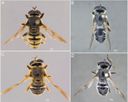
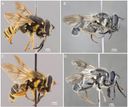
Pronunciation
How to pronounce Sphecomyia pseudosphecomima: /ˌsfɛkoʊˈmaɪə ˌsjuːdoʊsfɛkoʊˈmaɪmə/
These audio files are automatically generated. While they are not always 100% accurate, they are a good starting point.
Identification
Distinguished from other Sphecomyia by the combination of: c bare only on basal third of wing (vs. basal two-thirds in related ); tergite 2 with single grey, medially-interrupted band placed medially; absence of scutellar vittae (placing it in S. pattonii group); and broadened fore . Most similar to other members of the S. pattonii species group, from which it differs in the specific wing and abdominal pattern characters above.
Images
Appearance
Large -mimicking hoverfly with yellow and black coloration. c of the wing bare only on the basal third (distinguishing it from with bare basal two-thirds). Tergite 2 with a single grey, medially-interrupted band placed medially on the tergite. Fore broadened. Scutellum without vittae (placing it in the S. pattonii group).
Distribution
United States.
Similar Taxa
- Sphecomyia vittataSimilar large -mimicking syrphid in same ; distinguished by presence of scutellar vittae (placing it in S. vittata group) and different wing c pattern
- Vespula maculifrons (Eastern Yellowjacket)Probable model for ; distinguished by having only two wings ( Diptera), short with , and lack of a constricted waist
More Details
Taxonomic history
Described as new (sp. n.) in Moran 2019 revision of world Sphecomyia. The Sphecomyia was redefined in this revision based on morphological synapomorphies including bare medial vitta extending ventrally from oral margin, bare gena, bare katepimeron, scutellum with at least margin densely , and narrow intersection of R1 with vein C.
Larval biology
Unknown for this . For Sphecomyia generally, larval is speculated to be similar to other Criorhinina (rot holes, decaying wood or roots), but this remains unconfirmed.