
Physoconops excisus
Wiedemann, 1830
thick-headed fly
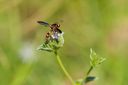
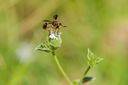
Physoconops excisus is a of thick-headed fly in the Conopidae. Like other members of the Physoconops, it exhibits mimicry, resembling potter wasps in appearance. Conopid flies are , with females attacking bees and wasps to deposit between their abdominal segments. The larvae develop as internal , eventually killing the .
Pronunciation
How to pronounce Physoconops excisus: //ˌfaɪsoʊˈkɒnəps ɛkˈsaɪsəs//
These audio files are automatically generated. While they are not always 100% accurate, they are a good starting point.
Identification
Can be distinguished from true by the single pair of wings (Diptera characteristic) versus two pairs in Hymenoptera. Distinguished from other conopid by genus-specific morphological traits; Physoconops resemble potter wasps with elongated and heavily pigmented wing margins. Distinguished from Physocephala by subtle morphological differences in and abdominal structure, though precise distinguishing features for P. excisus specifically are not documented in available sources.
Images
Habitat
Associated with flower-rich environments where (bees and ) are active. Found in areas where bumble bees and other hymenopteran hosts occur.
Distribution
Exact geographic range not specified in available sources; Physoconops occurs in North America.
Seasonality
activity timing not specifically documented for this . Related conopids in temperate regions typically have adults active in summer, with some southern potentially having multiple .
Diet
feed on nectar from flowers. Larvae are internal of bees and , feeding on tissues.
Host Associations
- Bumble bees - Based on -level ; specific records for P. excisus not documented in available sources.
- Solitary wasps - Based on and -level patterns; specific records for P. excisus not documented.
Life Cycle
Females attack bees or in mid-air, forcing them to the ground and ramming an between the host's abdominal segments. Larva hatches and feeds as an internal , killing the host in approximately 10-12 days. Larva pupates inside the hollow of the host. timing varies; in similar European , adults emerge the following summer, though southern may have multiple .
Behavior
Females actively pursue hymenopterans in to oviposit. frequent flowers for nectar, where they also wait for potential hosts. Known as 'living missiles' due to rapid aerial pursuit of hosts.
Ecological Role
Acts as a of bees and , potentially regulating . nectar-feeding may contribute to pollination, though this is secondary to their parasitic lifestyle.
Human Relevance
Not directly harmful to humans; does not bite or feed on blood. May be mistaken for stinging due to mimicry. Of interest to entomologists studying - interactions and mimicry.
Similar Taxa
- Physocephala tibialisAlso a conopid mimic with similar potter wasp-like appearance; distinguished by subtle differences in shape, abdominal proportions, and specific wing venation patterns.
- Potter wasps (Vespidae: Eumeninae)Convergent mimicry target; true have two pairs of wings and a constricted petiole (wasp waist), while P. excisus has one pair of wings and the 'waist' is a mimetic elongation of the rather than a true petiole.
- Zodion speciesSmaller conopids (5-7 mm versus 12-15 mm for Physoconops) that also parasitize solitary ; distinguished by size and more slender build.
More Details
Wasp mimicry function
The resemblance to potter wasps, including the pigmented wing margin that mimics the wing fold of resting , is believed to provide protection from that avoid stinging hymenopterans.
Taxonomic note
The was described by Wiedemann in 1830. The Physoconops is part of the diverse North American conopid fauna, which includes approximately 66 species across nine genera.