
Physocephala
Schiner, 1861
thick-headed flies
Species Guides
7- Physocephala burgessi(thick-headed fly)
- Physocephala floridana(thick-headed fly)
- Physocephala furcillata(thick-headed fly)
- Physocephala marginata(thick-headed fly)
- Physocephala sagittaria(thick-headed fly)
- Physocephala texana(thick-headed fly)
- Physocephala tibialis(thick-headed fly)
Physocephala is a of thick-headed flies ( Conopidae) comprising that develop as internal of bees and . are wasp mimics with elongated and heavily pigmented wing margins that resemble the folded wings of potter wasps. Females attack in mid-air, forcibly depositing between abdominal segments. The larvae feed internally, typically killing the host within 10–12 days before pupating inside the hollow .

Pronunciation
How to pronounce Physocephala: //ˌfaɪsoʊˈsɛfələ//
These audio files are automatically generated. While they are not always 100% accurate, they are a good starting point.
Identification
Distinguished from true by single pair of wings (Diptera), reduced hindwings modified as , and beak-like mouthparts. Separated from other conopid by larger size (vs. Zodion at 5–7 mm), elongated wasp-waisted , and heavily pigmented wing margin. Differs from Physoconops in specific wing venation and abdominal proportions. Presence on flowers near and wasp activity supports identification.
Images
Appearance
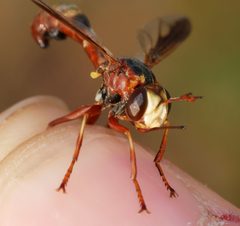
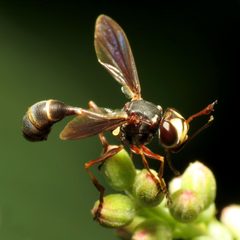
are 12–15 mm in length with large relative to body size, giving the its . The head is dominated by large . The is elongated and narrow, creating a '-waisted' silhouette. The front margin of the wing is heavily pigmented, mimicking the longitudinal fold in resting potter wasp wings. Mouthparts are beak-like and adapted for nectar feeding.
Habitat
Associated with flowering plants where feed on nectar and seek . Found in prairies, grasslands, and open supporting of bees and . Distribution records include Denmark, Norway, Sweden, Vermont (USA), and Argentina.
Distribution
Widespread in Holarctic and Neotropical regions. Documented from North America (including Vermont and Colorado), Europe (Denmark, Norway, Sweden), and South America (Argentina). Specific distributions vary; P. wulpi recorded from Neotropical Region, P. tibialis from eastern North America.
Seasonality
active during flowering periods of -associated plants. In Colorado, observed on White Prairie Clover (Dalea candida) blooming June–August. P. tibialis emerges from hosts the summer following ; southern may have multiple .
Diet
feed on nectar from flowers. Larvae are obligate internal , feeding on tissues of living hymenopteran .
Host Associations
- Bombus impatiens - P. tibialis
- Xylocopa artifex - P. wulpi
- Xylocopa augusti - P. wulpi
- Xylocopa splendidula - P. wulpi
- Megachile bomplandensis - P. inhabilis
- Bembix spp. - P. texana
- Centris analis - Physocephala spp.
Life Cycle
Females deposit directly into body cavity during aerial attack. Larvae hatch and feed internally as , killing host in 10–12 days. Larva pupates within hollow host . emerges following pupal ; in temperate regions, possibly multivoltine in southern climates. , mouthparts, and legs used for from within host.
Behavior
Females exhibit active -seeking , lurking on flowers to ambush bees and . Attack involves aerial pursuit, forcing host to ground, and ramming between abdominal plates using specialized ovipositor. Parasitized hosts may exhibit altered behavior: Centris analis females deposit extra oil on nest closures and construct empty nest , potentially as defense against secondary .
Ecological Role
Internal of solitary and social bees and , including important such as bumble bees, carpenter bees, and leafcutter bees. regulator of hymenopteran . Indirectly affects pollination services through host mortality.
Human Relevance
No direct medical or veterinary significance; does not parasitize humans. Of ecological interest as of . mimicry may cause misidentification by observers. Studied for unique parasitic and manipulation .
Similar Taxa
- PhysoconopsSimilar -mimicking conopid ; differs in wing venation and abdominal shape
- ZodionSmaller conopid (5–7 mm vs. 12–15 mm) attacking solitary ; less elongated
- Eumeninae (potter wasps)Mimicry target; true have two wing pairs, different wing folding, and stinger
More Details
Host manipulation
Parasitized Centris analis females exhibit extended nest-site fidelity (5.4 days post-closure), extra oil depositions on nest plugs, and construction of empty decoy — interpreted as defense against the Leucospis cayennensis that may incidentally protect developing conopid larvae.
Taxonomic note
established by Schiner in 1861. Contains approximately 66 in North America across nine genera of Conopidae; Physocephala is among the largest and most frequently encountered.
Sources and further reading
- BugGuide
- Wikipedia
- GBIF taxonomy match
- iNaturalist taxon
- NCBI Taxonomy
- Catalogue of Life
- Bug Eric: Wasp Wednesday: Not Wasp II
- Bug Eric: White Prairie Clover: An Awesome Blossom
- Host records of Physocephala wulpi Camras, with a description of the puparium (Diptera: Conopidae)
- Physocephala inhabilis (Diptera: Conopidae) as a parasitoid of Megachile (Sayapis) bomplandensis (Hymenoptera: Megachilidae) in Argentina
- Biology and seasonal incidence of Physocephala (Diptera: Conopidae) on Carpenter Bees (Hymenoptera: Apidae)
- The identity ofPhysocephala bimarginipennisKarsch (Diptera, conopidae) with notes on the immature stages and biology
- Deposições de Óleo por Fêmeas de Centris analis (Fabricius) (Hymenoptera: Apidae: Centridini) Parasitadas por Physocephala spp. (Diptera: Conopidae)
- The ecology and identification of common parasitoids (Diptera: Conopidae: Physocephala) in central and mid-coast Maine and behavioral changes of the bumble bee hosts
- Eclosion of <i>Physocephala tibialis</i> (say) (Diptera: Cnopidae) from a <i>Bombus</i> (Apidae: Hymenoptera) host: A video record