
Zodion
Latreille, 1796
thick-headed flies
Species Guides
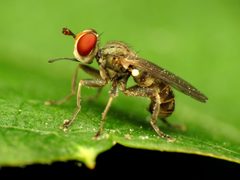
5Zodion is a of thick-headed flies in the Conopidae. These flies are notable for their parasitic lifestyle, with females attacking solitary in mid-air to deposit between the 's abdominal plates. The larvae develop as internal , eventually killing the host. in this genus are relatively small, measuring 5-7 millimeters in length, and are found in North America and Europe.
Pronunciation
How to pronounce Zodion: /ˈzoʊdiˌɒn/
These audio files are automatically generated. While they are not always 100% accurate, they are a good starting point.
Identification
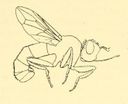
Zodion can be distinguished from other conopid by their smaller size (5-7 mm versus 12-15 mm for Physocephala) and less pronounced -mimicry. Unlike Physocephala and Physoconops, which closely resemble potter wasps with elongated 'wasp waists' and heavily pigmented wing margins that mimic folded wasp wings, Zodion has a more generalized appearance. The genus is specifically associated with of solitary wasps rather than bees.
Images
Habitat
Found in open including prairies and grasslands where are active. frequent flowers where they feed on nectar and seek hosts.
Distribution
Recorded from Europe (Denmark, Norway, Sweden) and North America. The is widespread across temperate regions.
Seasonality
are active during the warmer months when flowering plants are available and are active. In southern climates, multiple may occur within a single season.
Diet
feed on nectar from flowers. Larvae are obligate internal of solitary , feeding on tissues and eventually killing the host.
Host Associations
- solitary wasps - Females attack in mid-air, forcing them to the ground and depositing between abdominal segments. Known include sand wasps in the Bembix.
Life Cycle
Females deposit directly into the bodies of through intersegmental . Larvae hatch and feed internally as , developing over approximately 10-12 days before pupating inside the hollowed of the host. emerge the following summer, though multiple may occur in warmer climates.
Behavior
Females exhibit active hunting , pursuing in and physically overpowering them to oviposit. are frequently observed on flowers, where they feed on nectar while awaiting opportunities to attack hosts.
Ecological Role
Acts as a agent of solitary . The parasitic relationship can significantly impact local wasp abundance and dynamics.
Human Relevance
No direct economic importance. Occasionally observed by entomologists and naturalists on flowers. Not known to parasitize humans or domestic animals.
Similar Taxa
- PhysocephalaLarger conopid (12-15 mm) with more pronounced -mimicry including elongated 'wasp waist' and wing pigmentation patterns that mimic folded potter wasp wings; primarily parasitizes bees rather than solitary wasps.
- PhysoconopsSimilar -mimicking conopid with elongated and pigmented wing margins; distinguished by specific morphological details of structure and associations.
More Details
Taxonomic note
The was established by Latreille in 1796. It contains numerous and represents one of the most species-rich genera within Conopidae.