
Physoconops
Szilády, 1926
thick-headed flies
Species Guides
13- Physoconops analis
- Physoconops brachyrhynchus(thick-headed fly)
- Physoconops bulbirostris(thick-headed fly)
- Physoconops discalis(thick-headed fly)
- Physoconops excisus(thick-headed fly)
- Physoconops floridanus(Florida physoconops)
- Physoconops fronto(thick-headed fly)
- Physoconops gracilis
- Physoconops nigrimanus(thick-headed fly)
Physoconops is a of thick-headed flies ( Conopidae) containing approximately 13 described . Members are mimics, resembling potter wasps in appearance and . The genus occurs primarily in the Neotropical and Andean regions, with some species in North America. Like other conopids, Physoconops species are endoparasitoids of bees and wasps.


Pronunciation
How to pronounce Physoconops: //ˌfaɪsəˈkoʊnɒps//
These audio files are automatically generated. While they are not always 100% accurate, they are a good starting point.
Identification
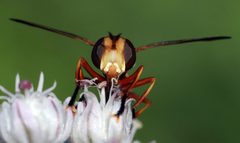
Physoconops closely resemble potter wasps (Vespidae: Eumeninae). Key distinguishing features include: elongated forming a ' waist'; heavily pigmented front margin of the wing, mimicking the longitudinal fold in a potter wasp's wing at rest; large relative to body size; and beak-like mouthparts used for nectar feeding. The combination of these traits separates Physoconops from true wasps, which have two pairs of wings (flies have one pair plus ) and different wing venation.
Images
Habitat
Associated with flowering vegetation where seek nectar. One , Physoconops tentenvilu, has been recorded from Valdivian evergreen forest in Chile.
Distribution
Neotropical and Andean regions; North America (including United States: Vermont, Florida); Chile (northern areas and southern extension to Valdivian region).
Diet
feed on nectar. Larvae are internal of bees and .
Life Cycle
Females attack bees or in mid-air, sometimes forcing them to the ground, and deposit an between the host's abdominal segments. The larva hatches and feeds as an endoparasitoid, killing the host in approximately 10-12 days. The larva then pupates inside the hollow of the host. occurs the following summer in temperate regions; multiple may occur in southern climates.
Behavior
frequent flowers to obtain nectar. Females actively pursue hymenopterans in to oviposit.
Ecological Role
Endoparasitoid of bees and ; regulator of hymenopterans.
Similar Taxa
- PhysocephalaAlso conopid mimics with similar ; Physocephala tend to be larger (e.g., P. tibialis 12-15 mm) and may show subtle differences in wing pigmentation patterns
- ZodionSmaller conopids (5-7 mm) that also parasitize solitary ; distinguished by reduced size and different body proportions
- Potter wasps (Eumeninae)Visual mimic; true have two pairs of wings, elbowed , and different wing venation and folding pattern