
Conopidae
Thick-headed Flies
Subfamily Guides
5- Conopinae(thick-headed flies)
- Dalmanniinae
- Myopinae
- Stylogastrinae
- Zodioninae
, commonly known as thick-headed flies, is a of flies within the suborder of Diptera and the sole member of the superfamily Conopoidea. The family comprises approximately 800 in 47 worldwide, with about 70 species found in North America. conopids are frequent flower visitors, feeding on nectar with their often elongated . The larvae of all conopids are internal , primarily of Hymenoptera (stinging and bees), with adult females aggressively intercepting in to deposit .

Pronunciation
How to pronounce Conopidae: //koʊˈnɒpɪˌdiː//
These audio files are automatically generated. While they are not always 100% accurate, they are a good starting point.
Identification
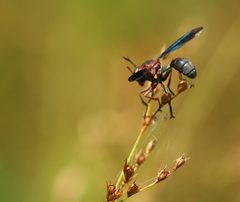
Conopids can be distinguished from similar-looking and bees by their single pair of wings ( Diptera characteristic) and reduced hindwings modified as . They differ from syrphid flies by their broad , often geniculate , and wing venation including a closed anal and very long first basal cell. The presence of an inflatable above the is diagnostic. Stylogaster are immediately recognizable by their highly elongated, needle-like female . Within the , can be distinguished by ocelli presence (Conopinae have ocelli, Myopinae lack them) and tibial bristles (Myopinae have preapical bristle, others do not). such as Physocephala and Physoconops resemble potter wasps with elongated abdomens and pigmented wing margins, while Conops and Myopa have different body proportions.
Images
Appearance
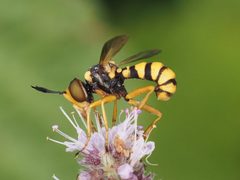
conopids are small to large flies ranging from 3–20 mm (usually 5–15 mm), with a characteristically broad that gives the its . The body is rather thinly pilose or nearly bare, elongate or stout, often lustrous with black and yellow or black and white color patterns, sometimes with reddish brown markings. Many strikingly resemble , bees, or syrphid flies. The is broad in both sexes. Ocelli may be present or absent depending on . have three segments, with the third bearing a bare or terminal style; an inflatable is present above the antennae. The is long, slender, and often geniculate (elbowed). The wing is usually clear, sometimes with dark markings along the ; wing venation includes a continuous costa, complete subcostal , closed anal , and a very long first basal cell. The base of the is often constricted, and female genitalia are frequently large or greatly elongated. Tibiae may have dorsal preapical bristles in some subfamilies.
Habitat
Conopids are found in diverse terrestrial worldwide, excluding polar regions and many Pacific islands. are most frequently encountered at flowers, particularly where their hymenopteran forage. Larval habitat is determined by host availability, as all larvae develop internally within Hymenoptera hosts. Some Stylogaster are associated with army ant colonies in tropical regions, though this association is not obligatory for all species in the .
Distribution
Worldwide distribution across all biogeographic realms except the poles and many Pacific islands. Approximately 70 occur in North America. The Stylogaster is most diverse in the Neotropics, sub-Saharan Africa, and Southeast Asia, with only two species in North America. The is represented in Colombia by 16 species in four genera, with Stylogaster being the richest group in that region. In Europe, several Myopa species are common in early spring among Salix catkins.
Seasonality
activity varies by and region. Myopa are commonly observed in early spring in Europe, flying among Salix catkins with their Andrena . Many conopid species appear to have single per year in temperate regions, with adults emerging in summer. In southern climates, some Physocephala species may have more than one generation annually. Stylogaster neglecta has been documented in August in Missouri.
Diet
feed exclusively on nectar using their long, slender, often geniculate . They are frequent visitors to flowers and have been observed scraping on fungal surfaces. Larvae are internal that consume tissues from within Hymenoptera hosts, eventually killing the host.
Host Associations
- Aculeata (stinging Hymenoptera) - primary Larvae are internal of and bees; most conopid utilize this group
- Bombus terrestris and other bumblebees - Vulnerable foraging bees are most susceptible to ; Physocephala are known
- Andrena (mining bees) - Myopa are associated with Andrena ; M. pellucida confirmed in A. nitida, M. hirsuta and M. testacea in A. vaga, M. vicaria in A. regularis
- Ceratina (small carpenter bees) - Physocephala tibialis has been observed parasitizing this
- Bembix (sand wasps) - Physocephala texana is a known of several Bembix
- Solitary wasps - Zodion attack solitary
- Crickets, cockroaches, calyptrate flies - Stylogaster are obligate of these groups, not Hymenoptera
- Army ants (Ecitoninae, Dorylinae) - mutualismSome Stylogaster are obligate associates, using raiding columns to flush prey; however, this is not obligatory for all Stylogaster species as the occurs in Madagascar and Africa where army ants are absent
Life Cycle
The involves internal of Hymenoptera. females aggressively intercept hosts in , using a modified described as a 'can opener' to pry open host abdominal segments and insert . In Stylogastrinae, eggs are harpoon-shaped with rigid barbed tips and are forcibly jabbed into hosts. Larvae hatch and develop as endoparasitoids within the living host, consuming host tissues over approximately 10–12 days before killing the host. The mature larva pupates inside the hollow host . Some Physocephala induce behavioral changes in hosts—P. tibialis causes infected bumblebees to bury themselves before death, allowing adult fly underground. Adults typically emerge the following summer, though some southern may have multiple . occurs as pupae within host remains.
Behavior
females exhibit aggressive -seeking , actively pursuing Hymenoptera in to force oviposition. This mid-air interception may involve grappling with the host and forcing it to the ground. Adult conopids are rapid, nervous fliers that are difficult to approach. Both sexes visit flowers for nectar, with some showing fidelity to particular floral resources associated with host activity. Males are not involved in host . Some Stylogaster species demonstrate association with army ant swarms, exploiting the disturbance to locate hosts.
Ecological Role
Conopids function as significant regulating of Hymenoptera, particularly bees and . They exert substantial on populations, with infected colonies showing reduced ability to produce sexual offspring in late summer. The has documented negative impacts on populations, especially bumblebees, with potential economic implications for colonies attacked by Physocephala . flower-visiting contributes to pollination, though this is incidental to their nectar-feeding. As parasitoids, they represent an important trophic link between floral resources and higher .
Human Relevance
Certain Physocephala have minor economic importance as of honey bees. The has been studied for its impacts on native , with concerns about -induced declines in bumblebee colonies. Conopids are of interest in research and parasitoid- evolutionary studies. They are occasionally encountered by entomologists and naturalists at flowers, though their rapid and -like appearance make them challenging subjects for observation and photography.
Similar Taxa
- Syrphidae (hoverflies)Many conopids, particularly Physocephala and Physoconops, strikingly resemble -mimicking syrphids in coloration and body form; distinguished by shape, structure, wing venation, and single pair of wings
- Vespidae (potter wasps, mason wasps)Conopids in Physocephala and Physoconops closely mimic potter wasps with elongated '-waisted' and wing folding patterns; distinguished by wing number, shape, and absence of wasp-like petiole constriction
- Apidae (bees)Black and yellow conopid color patterns mimic bees; distinguished by wing structure, absence of branched body hairs, and
- Asilidae (robber flies)Both include predatory/parasitic flies with robust bodies; distinguished by conopid shape, structure, and parasitic versus predatory
More Details
Morphological specializations
The female in most conopids is modified with structures that function as a 'can opener' to separate abdominal segments during oviposition. Stylogastrinae possess uniquely modified harpoon-shaped with rigid barbed tips, representing a distinct evolutionary solution to the challenge of penetrating host .
Taxonomic diversity
The is divided into including Conopinae (with ocelli), Myopinae (lacking ocelli, with tibial bristles), and Stylogastrinae (highly modified and , parasitizing non- ). The Stylogaster alone contains 92 described , with only two in North America.
Research needs
Stuke (2017) notes that the vast majority of records in literature do not meet criteria for unambiguous acceptance, highlighting significant gaps in confirmed host- associations. of most conopid remain poorly documented, and the actual host ranges of common species like Myopa testacea remain uncertain due to historical taxonomic confusion.
Sources and further reading
- BugGuide
- Wikipedia
- GBIF taxonomy match
- iNaturalist taxon
- NCBI Taxonomy
- Catalogue of Life
- Conopidae | Beetles In The Bush
- Bug Eric: Sand Wasps, Genus Bembix
- Bug Eric: April 2011
- Diptera | Beetles In The Bush | Page 8
- Northern Ireland, invertebrate finds in review 2023 - Buglife Blog - Buglife
- Bug Eric: The Mason Wasp Euodynerus foraminatus Endorses Bee Blocks
- Conopidae larvae (Diptera: Conopidae) as endoparasitoids of Aculeata
- FAMILY CONOPIDAE
- Parasitic behavior of the larvae of the Conopidae family (Diptera: Conopidae)
- The evolutionary biology of Conopidae (Diptera) : a life history, molecular, morphological, systematic, and taxonomic approach
- Revision of the Myopa testacea Species-Group in the Palaearctic Region (Diptera: Conopidae)
- First host record of Myopa pellucida Robineau-Desvoidy (Diptera: Conopidae) identified using DNA barcoding
- Death and diminishment: parasitoid flies (Diptera: Conopidae) reduce foraging efficiency before killing their bumblebee host.