
Physocephala tibialis
(Say, 1829)
thick-headed fly
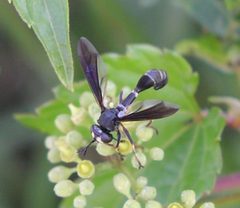
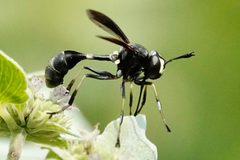
Physocephala tibialis is a fly in the Conopidae that develops within the of bees, particularly bumble bees (Bombus spp.). are primarily black with yellow facial markings and thin white abdominal stripes, and are frequently observed near flowering plants where they locate . The exhibits remarkable host manipulation, inducing infected bees to bury themselves before death, which protects the developing pupa underground.

Pronunciation
How to pronounce Physocephala tibialis: //ˌfaɪ.soʊˈsɛf.ə.lə tɪˈbaɪ.ə.lɪs//
These audio files are automatically generated. While they are not always 100% accurate, they are a good starting point.
Identification
Distinguished from similar conopids by the combination of yellow lateral facial areas with black stripe, black unspotted cheeks, and specific wing venation pattern with brown coloration radiating from the . Resembles potter wasps (Vespidae: Eumeninae) in general form, but possesses the beak-like and single pair of wings characteristic of Diptera. Distinguished from Physoconops by coloration and wing patterns.
Images
Habitat
Found in association with flowering plants where bees forage. Does not show preference for specific plant , attacking hosts across diverse floral resources. Distribution spans eastern deciduous forests, suburban gardens, and agricultural areas with adequate .
Distribution
Eastern North America from Massachusetts south to Florida, west to Wisconsin and Texas. Core range along Atlantic coastal plain and interior eastern states.
Seasonality
active during warm months when bees are foraging. Pupal extends 154–190 days, typically ; adult following spring/summer warming. Multiple possible in southern portions of range.
Host Associations
- Bombus impatiens - primary Common eastern bumblebee; documented rearing record from video analysis
- Bombus spp. - Multiple parasitized; specificity varies by locality
- Hymenoptera: Apoidea - General order; specific associations primarily with bees
Life Cycle
Female deposits single into through intersegmental during host foraging. Egg hatches in 1–2 days; larva undergoes three instars over 10–12 days within living host. First and second instars feed on ; third instar consumes intestinal tissue. Host dies at larval maturity; larva pupates within host corpse in soil. Extended pupal period (154–190 days) includes . emerges using , mouthparts, and legs to rupture and excavate to surface.
Behavior
Females perch near flowering plants and ambush foraging bees, forcing to ground to oviposit. Induces grave-digging in infected hosts: parasitized bees bury themselves before death, positioning pupa underground. This manipulation varies by host (70% in Bombus impatiens vs. 18% in Bombus griseocollis). Parasitized hosts also exhibit altered flower preferences, selecting non- plant species and foraging more sporadically. involves rhythmic inflation/deflation combined with mouthpart and leg leverage to escape host remains and soil.
Ecological Role
regulating native . manipulation influences bee foraging and pollination patterns through altered flower preferences. Serves as food source for underground and decomposers during pupal stage.
Human Relevance
Documented in health studies due to impacts on . Potential concern for commercial bumble bee rearing operations. Subject of behavioral research regarding manipulation mechanisms.
Similar Taxa
- Physocephala texanaSimilar congeneric ; distinguished by distribution (western) and associations with sand wasps (Bembix spp.) rather than bumble bees
- Physoconops spp.Conopid flies with similar -mimic appearance; differ in coloration patterns and wing venation details
- Zodion intermediumSmaller conopid (5–7 mm) parasitizing solitary ; distinguished by size and guild
More Details
Eclosion Mechanics
Video documentation confirms P. tibialis uses a three-part system: ruptures and ; mouthparts and legs provide leverage; rhythmic ptilinum inflation/deflation enables soil excavation to surface. Sclerotized ptilinal enhance mechanical for both host exit and soil penetration.
Host Manipulation Variability
Induced grave-digging shows - dependent expression. Mechanism unknown but adaptive outcome documented: flies emerging from underground are larger, heavier, and have lower of wing malformations compared to ground-level .
Sources and further reading
- BugGuide
- Wikipedia
- GBIF taxonomy match
- iNaturalist taxon
- NCBI Taxonomy
- Catalogue of Life
- Bembicid Holdings | Entomology Research Museum
- Meloidae Holdings | Entomology Research Museum
- Bug Eric: April 2011
- And Then There Were Three: New Termite Species Identified in California
- New Method Makes for Faster Genetic ID of Eastern U.S. Termites
- Western U.S. Has More Subterranean Termite Species Than Previously Thought, Study Shows
- Eclosion of <i>Physocephala tibialis</i> (say) (Diptera: Cnopidae) from a <i>Bombus</i> (Apidae: Hymenoptera) host: A video record