
Physocephala texana
(Williston, 1882)
thick-headed fly
Physocephala texana is a of thick-headed fly in the Conopidae. It is an internal of bumble bees, specifically Bombus vosnesenskii. The female fly intercepts bees in mid-air and forcibly deposits an between the 's abdominal segments. The larva develops inside the living , eventually killing it and pupating within the hollow . flies are mimics with elongated and heavily pigmented wing margins that resemble the folded wings of potter wasps.
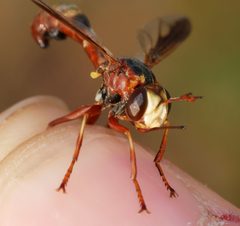
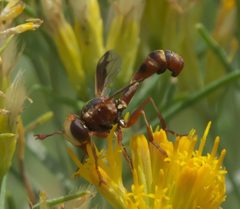
Pronunciation
How to pronounce Physocephala texana: /ˌfaɪsoʊˈsɛfələ tɛkˈsænə/
These audio files are automatically generated. While they are not always 100% accurate, they are a good starting point.
Images
Host Associations
- Bombus vosnesenskii - Internal ; female deposits between abdominal segments of in mid-air interception
Behavior
Females actively pursue bumble bees in , forcing them to the ground and using their beak-like mouthparts to ram an between the 's abdominal plates. The larva feeds as an internal for approximately 10-12 days before killing the host. The larva then pupates inside the hollow of the dead , with the fly emerging the following summer.
Ecological Role
of bumble bees; of
Similar Taxa
- Physocephala tibialisSimilar -mimicking appearance and conopid lifestyle, but attacks different groups
- Zodion intermediumAnother conopid fly that parasitizes solitary , but much smaller (5-7 mm vs. 12-15 mm) and with different preferences
- Physoconops spp.Related conopid with similar -mimic and thick-headed appearance
More Details
Parasitoid biology
The strategy of Physocephala texana represents a derived form of kleptoparasitism where the is eventually killed rather than merely exploited. The mid-air interception requires precise coordination and represents a specialized to attacking fast-flying hymenopteran hosts.