
Myopa clausa
Loew, 1866
Thick-headed Fly
Pronunciation
How to pronounce Myopa clausa: /ˈmaɪ.oʊ.pə ˈklɔː.zə/
These audio files are automatically generated. While they are not always 100% accurate, they are a good starting point.
Identification
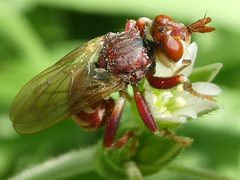
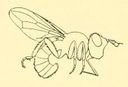
Members of the Myopa can be recognized by their stout body, broad , and characteristic posture where the partially curves under. Specific identification of M. clausa requires examination of detailed morphological characters; the genus is taxonomically challenging and seldom recorded.
Images
Distribution
Recorded from Canada and the United States, with specific distribution records from Vermont and other US localities.
Host Associations
- Hymenoptera - internal Like all Conopidae, Myopa clausa is an internal of bees and . The specific for M. clausa has not been confirmed.
Ecological Role
As a of bees and , contributes to of Hymenoptera.
Similar Taxa
- Myopa tessellatipennisBoth are members of the Myopa with similar parasitic and general ; M. tessellatipennis is a spring-active with possible association with Andrena barbilabris.
- Sicus ferrugineusBoth are Conopidae and internal of Hymenoptera, but Sicus has a more elongated body form and different associations.
- Conops quadrifasciatusBoth are Conopidae with similar parasitic , but Conops is more commonly encountered and has distinctive banded coloration.
More Details
Taxonomic note
The Myopa is taxonomically difficult and are seldom recorded, which may reflect both genuine rarity and under-recording due to identification challenges.
Sources and further reading
- BugGuide
- Wikipedia
- GBIF taxonomy match
- iNaturalist taxon
- NCBI Taxonomy
- Catalogue of Life
- Bluelegged Grasshopper
- Northern Ireland, invertebrate finds in review 2023 - Buglife Blog - Buglife
- Bug Eric: Blue-legged Grasshopper
- The (almost) Florida-endemic Cicindelidia scabrosa | Beetles In The Bush
- Cimbicidae | Beetles In The Bush