
Myopa
Fabricius, 1775
thick-headed flies, beegrabbers
Species Guides
4- Myopa clausa(Thick-headed Fly)
- Myopa rubida
- Myopa vesiculosa
- Myopa vicaria
Myopa is a of thick-headed flies ( Conopidae) comprising approximately 35 described distributed across the Holarctic and Neotropical regions. These flies are internal of bees, with confirmed including Andrena vaga, Andrena nitida, and Andrena regularis. Females intercept host bees in and oviposit between abdominal segments. Several species are common in early spring among Salix catkins, though the genus is generally under-recorded due to identification difficulties.
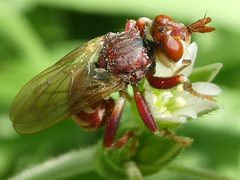
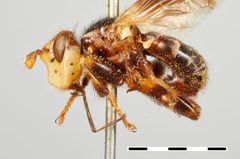

Pronunciation
How to pronounce Myopa: /ˈmaɪ.oʊ.pə/
These audio files are automatically generated. While they are not always 100% accurate, they are a good starting point.
Identification
Members of Myopa can be distinguished from other Conopidae by a combination of characters including wing venation patterns and . -level identification requires examination of specific morphological features and is considered difficult, contributing to the being seldom recorded in many regions. The Myopa testacea species group has been subject to taxonomic revision, with seven valid species recognized in the Palaearctic.
Images
Habitat
Early spring in Europe, particularly areas with Salix catkins. Mediterranean in central Chile for some Neotropical . Habitats may be threatened by land use change in some regions.
Distribution
Holarctic distribution with records from Europe (including Denmark, Norway, Sweden), North America (Vermont, USA), and the Palaearctic region. Neotropical records include Mexico and Chile, with two recently described from central Chile (Myopa nebulosa, Myopa bozinovici). Southern South American species are poorly represented in collections.
Seasonality
Early spring activity in European , with observed flying among Salix catkins during this period.
Host Associations
- Apis mellifera - reported but not confirmed via rigorous criteria
- Andrena - -level association; confirmed for A. vaga, A. nitida, A. regularis
- Andrena vaga - confirmed for M. hirsuta and M. testacea
- Andrena nitida - confirmed for M. pellucida; identified via
- Andrena regularis - confirmed for M. vicaria
- Anthophora - mustache bees; reported but not confirmed via rigorous criteria
- Andrena barbilabris - suspected for M. tessellatipennis; inferred from co-occurrence at mating , not confirmed
Life Cycle
Internal development within bees. Second instar larvae develop in the of host females. Specific details of , larval, and pupal stages are poorly documented for most .
Behavior
Ecological Role
Human Relevance
Potential impact on through of bees, though population-level effects are unstudied. Identification difficulties limit monitoring and conservation assessment.
Similar Taxa
More Details
Taxonomic challenges
The Myopa contains groups with complex taxonomic histories, such as the M. testacea group where species boundaries were historically confused. Recent revisions have clarified species limits but identification remains difficult, contributing to under-recording. Myopa strandi Duda, 1940 was synonymized with M. vicaria Walker, 1849.
Host record reliability
Most historical records for Myopa are considered doubtful according to Stuke (2017) criteria, which require: (1) rearing or confirmation, (2) unambiguous conopid identification, and (3) unambiguous host identification. Only four host associations currently meet these criteria for unambiguous acceptance.
Conservation status
Myopa are generally not abundant and their may be threatened by land use change. The is under-represented in museum collections, particularly in southern South America where knowledge gaps remain significant.
Genomic resources
sequences are available for Myopa tessellatipennis and Myopa testacea through the Wellcome Sanger Institute's Darwin Tree of Life project.
Sources and further reading
- BugGuide
- Wikipedia
- GBIF taxonomy match
- iNaturalist taxon
- NCBI Taxonomy
- Catalogue of Life
- Northern Ireland, invertebrate finds in review 2023 - Buglife Blog - Buglife
- Myopa nebulosa sp. nov. and Myopa bozinovici sp. nov. (Diptera: Conopidae): New thick-headed flies from a threatened biodiversity hotspot in central Chile
- First host record of Myopa pellucida Robineau-Desvoidy (Diptera: Conopidae) identified using DNA barcoding
- Revision of the Myopa testacea Species-Group in the Palaearctic Region (Diptera: Conopidae)
- New records and updated distribution of Myopa metallica Camras 1992 (Diptera: Conopidae: Myopinae) in Chile by using integrative collection methods
- The genome sequence of a conopid fly, Myopa testacea (Linnaeus, 1767).
- The genome sequence of the thick-headed fly, Myopa tessellatipennis (Motschulsky, 1859).
- Statin-induced necrotizing autoimmune myopathy: a systematic review.