
Andrena barbilabris
(Kirby, 1802)
Bearded Miner Bee, Long-lipped Miner, Sandpit Mining Bee
A solitary mining bee with a Holarctic distribution, found across Europe, northern Asia, and North America. Females excavate nesting burrows in sandy soils, provisioning with pollen and nectar before laying single . The exhibits in coloration and is active from early spring through mid-summer.
Pronunciation
How to pronounce Andrena barbilabris: /ænˈdrɛ.nə bɑːr.bɪˈlæb.rɪs/
These audio files are automatically generated. While they are not always 100% accurate, they are a good starting point.
Identification
Distinguished from similar Andrena by the combination of thoracic hairs in females, silvery male coloration, and narrow shape. The specific epithet 'barbilabris' (bearded lip) refers to distinctive facial hair characteristics. Nesting in sandy soils provide additional field recognition cues.
Images
Appearance
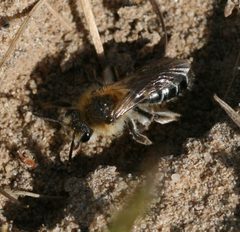
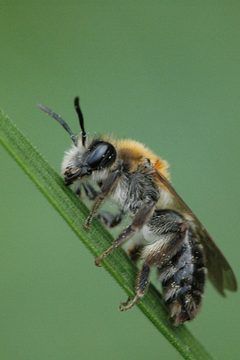
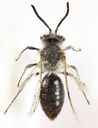
Medium-sized mining bee approximately 11 mm in length. Females larger and more robust than males, with hairs on the contrasting with yellower hairs on the sides and . Males appear silvery due to long pale thoracic hairs. predominantly black. Narrow head creates a hunch-backed appearance.
Habitat
Strongly associated with light, sandy soils. Nests in loose sandy ground, including riverbanks, heathlands, and even garden paths between paving stones. Forms small nesting in sparsely vegetated or bare ground patches.
Distribution
Holarctic distribution spanning North America (southern Canada, northern United States), Europe from western regions to Anatolia, and northern Asia including western and eastern Siberia (Yakutia, Primorsky Krai), Russian Far East, and Japan. In Britain and Ireland, patchy and localized distribution extending north to Inverness, scarcer in Ireland. Present on Guernsey and Jersey in the Channel Islands.
Seasonality
emerge in early spring, with period from March to July. Males typically emerge before females.
Diet
forager on wide variety of flowers; willows are preferred foraging plants. Foraging range typically within 300 meters of nests.
Life Cycle
Females excavate underground burrows in sandy soil, creating small provisioned with pollen mixed with nectar. A single is laid on each pollen ball and sealed into its cell. Larvae develop within sealed cells. Nest location relies on olfactory cues rather than visual markers; nests hidden under thin layer of sand.
Behavior
Solitary but forms small nesting . Females rely on sense of smell to locate concealed nest entrances. Rapid excavation into nests observed when returning. Males patrol nesting areas seeking emerging females.
Ecological Role
Human Relevance
Occurs in gardens and urban environments where sandy nesting substrate is available. Subject to conservation concern where degradation reduces bare sandy ground availability. Management techniques including creation of ' beaches' have been implemented to support .
Similar Taxa
- Andrena nigroaeneaSimilar size and spring , but lacks thoracic hairs and has different facial markings; prefers clay soils over sandy substrates.
- Andrena cinerariaDistinct black and white coloration contrasts with /yellow pattern of A. barbilabris; active slightly later in season.
More Details
Parasite Association
The specialized Sphecodes pellucidus is strongly associated with this ; observers often detect A. barbilabris presence by watching S. pellucidus digging into sand to locate nests.
Conservation Management
Experimental ' beach' creation using sand spreading and soil has demonstrated rapid by this , with individuals observed basking and nesting on newly created bare ground patches within short timeframes.
Sources and further reading
- BugGuide
- Wikipedia
- GBIF taxonomy match
- iNaturalist taxon
- NCBI Taxonomy
- Catalogue of Life
- Northern Ireland, invertebrate finds in review 2023 - Buglife Blog - Buglife
- Not-so Solitary Bees - Buglife Blog - Buglife
- What’s in a name….? - Buglife Blog - Buglife
- In a New Study, Spring Forest Bees Get Their Due
- Bare ground experiments to help save rare bees and wasps - Buglife Blog - Buglife
- Bees of the Changing Chalk Partnership Area - Buglife Blog - Buglife