
Physocephala floridana
Camras, 1957
thick-headed fly
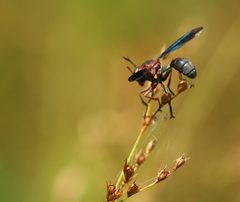
Physocephala floridana is a of thick-headed fly in the Conopidae. Members of this are known to parasitize bees and , with females attacking in mid-air to deposit between abdominal segments. The larvae develop as internal , eventually killing the host. This species has been recorded from the northeastern United States, including Vermont.
Pronunciation
How to pronounce Physocephala floridana: /ˌfaɪ.soʊˈsɛf.ə.lə ˌflɔːr.ɪˈdeɪ.nə/
These audio files are automatically generated. While they are not always 100% accurate, they are a good starting point.
Identification
Members of the Physocephala can be recognized by their large, rounded relative to body size, beak-like mouthparts used for nectar feeding, and -mimicking appearance with an elongated, constricted resembling a 'wasp waist.' The front margin of the wing is heavily pigmented, mimicking the longitudinal fold in a potter wasp's wings at rest. -level identification requires examination of specific morphological characters not detailed in available sources.
Images
Habitat
Has been observed in areas where bumble bees and other hymenopteran occur, typically associated with flowering vegetation.
Distribution
Recorded from Vermont and other parts of the northeastern United States.
Diet
feed on nectar from flowers. Larvae are internal of bees and .
Host Associations
- bumble bees - females attack in mid-air, forcing to ground and depositing between abdominal segments
- solitary wasps - other Physocephala known to attack sand wasps and other solitary ; specific records for P. floridana not documented
Life Cycle
Females attack hymenopterans in mid-, sometimes forcing them to the ground, and ram an between the host's abdominal segments. The larva hatches and feeds internally as a , eventually killing the host in approximately 10-12 days. The larva then pupates inside the hollow of the host. timing is not well documented for this ; related species may have one per year in northern climates or multiple generations in southern regions.
Behavior
Females are known to actively pursue bees and in , engaging in aerial attacks to oviposit. frequent flowers for nectar. Males and females both exhibit wasp-mimicking appearance and flight .
Ecological Role
Acts as a of bees and , potentially regulating of these and . The ecological impact of this specifically has not been quantified.
Human Relevance
No direct human relevance documented. Indirectly may affect through .
Similar Taxa
- Physocephala tibialissimilar -mimicking appearance, size range (12-15 mm), and lifestyle attacking bumble bees; distinguished by specific morphological characters and geographic distribution
- Physocephala texanasimilar -level traits including of solitary ; distinguished by associations and morphological details
- Physoconops speciessimilar conopid flies that also mimic potter wasps; distinguished by -level morphological characters
Sources and further reading
- BugGuide
- Wikipedia
- GBIF taxonomy match
- iNaturalist taxon
- Catalogue of Life
- Rediscovery of Cicindela scabrosa floridana | Beetles In The Bush
- Photographing the Newly Rediscovered Cicindelidia floridana | Beetles In The Bush
- The (almost) Florida-endemic Cicindelidia scabrosa | Beetles In The Bush
- Mini-review of the Cicindelidia abdominalis species-group | Beetles In The Bush
- Why I Roamed the Marsh at Night | Beetles In The Bush
- Bug Eric: April 2011