
Paradejeania
Brauer & Bergenstamm, 1893
Spiny Tachinid Fly, Hedgehog Fly
Species Guides
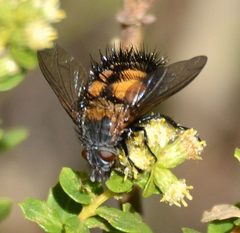
1- Paradejeania rutilioides(spiny tachina fly)
Paradejeania is a of tachinid flies comprising four described . The genus is characterized by an exceptionally spiny , earning species like P. rutilioides the "Hedgehog Fly." These are large, robust flies that visit flowers for nectar and function as of caterpillars. The genus occurs in western North America, with active primarily in late summer and fall.

Pronunciation
How to pronounce Paradejeania: //ˌpæɹəˌdiːˈʒeɪniə//
These audio files are automatically generated. While they are not always 100% accurate, they are a good starting point.
Identification
Most readily distinguished from other tachinid by the dense covering of long spines on the . Can be confused with Adejeania, but Paradejeania is larger, more robust, more spiny, and has more subdued orange coloration. Unlike Adejeania vexatrix, Paradejeania lacks the elongated, beak-like palps that form a around the mouthparts.
Images
Appearance
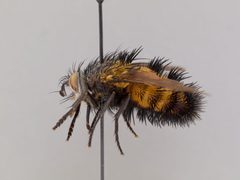
Large, robust tachinid flies with extremely spiny . The abdomen is covered in long, obvious spines that project outward, creating a hedgehog-like appearance. Body coloration tends toward subdued orange. More robust and spinier than the related Adejeania.
Habitat
Found in forested and open where late-season wildflowers occur. Frequently observed on flowers of rabbitbrush (Chrysothamnus/Ericameria).
Distribution
Western North America, ranging from British Columbia and Alberta south through California, Arizona, and New Mexico. P. rutilioides is divided into two geographically separated , one northern and one southern.
Seasonality
active primarily in August, September, and October. Stragglers may persist into November or December in some areas.
Diet
feed on nectar from flowers, particularly late summer and fall wildflowers such as rabbitbrush.
Host Associations
- Hemihyalea edwardsii - Edwards' Glassy-wing tiger moth caterpillars; documented for P. rutilioides
Behavior
visit flowers for nectar. lifestyle involves laying on or near caterpillar .
Ecological Role
agent through of caterpillars. Important flower visitor that complements like bees.
Human Relevance
Beneficial insects that help control pest caterpillar . No known negative impacts.
Similar Taxa
- AdejeaniaBoth are large, flower-visiting tachinids in western North America. Adejeania is slightly smaller, brighter in color, has beak-like elongated palps, and is less spiny. Paradejeania is more robust, more spiny, and has subdued orange coloration.
- Macromya crocataResembles Adejeania vexatrix but lacks the beak-like palps; not as spiny as Paradejeania.
- Hystricia abruptaAnother tachinid frequently mistaken for Adejeania vexatrix, but lacks the beak and is less spiny than Paradejeania.
More Details
Common names
P. rutilioides is known as "Spiny Tachinid Fly" or "Hedgehog Fly," the latter coined by fly expert Stephen A. Marshall.
Species diversity
The contains four described : P. colombiensis, P. nigrescens, P. rutilioides, and P. xenisma.