
Adejeania
Townsend, 1913
orange bristle fly
Species Guides
1- Adejeania vexatrix(Orange Bristle Fly)
Adejeania is a of tachinid flies native to the Americas, with most occurring in South America. The genus name derives from an alteration of 'Dejeania,' meaning 'not Dejeania.' The most widely distributed species, A. vexatrix, ranges from Mexico through western North America to British Columbia and Alberta. These flies are of caterpillars and are important flower visitors in late summer and fall.
Pronunciation
How to pronounce Adejeania: /ˌædɪˈdʒeɪniə/
These audio files are automatically generated. While they are not always 100% accurate, they are a good starting point.
Identification
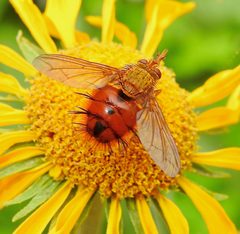
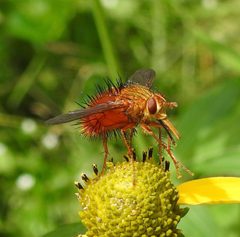
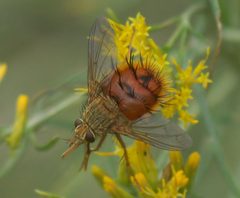
Adejeania are large tachinid flies with characteristically spiny covered in long, obvious bristles. A. vexatrix can be distinguished from similar by its elongated palps that form a around the mouthparts, creating a distinctive 'beak-like' appearance. The species is slightly smaller and brighter orange in color than Paradejeania rutilioides, and lacks the more robust, spinier build of that species. Unlike Macromya crocata and Hystricia abrupta, which occur in similar , A. vexatrix possesses the distinctive beak formed by elongated palps.
Images
Habitat
in this occupy varied across the Americas. A. vexatrix occurs in forested and open habitats of western North America, including alpine coniferous forests, ponderosa pine woodlands, and areas with flowering rabbitbrush. South American species are recorded from Colombia, Peru, Venezuela, Brazil, Ecuador, and other countries, suggesting tropical to subtropical forest and open country habitats.
Distribution
The is distributed throughout the Americas. Most are South American, with records from Brazil, Colombia, Peru, Venezuela, Ecuador, Mexico, Panama, and Cuba. A. vexatrix has the broadest distribution, occurring from Mexico north through the western United States (California, Arizona, New Mexico, Nevada, Utah) to British Columbia and Alberta in Canada.
Seasonality
A. vexatrix are active from July through August in northern parts of their range, with activity extending into September or October in more southerly areas. The declines in abundance toward autumn. Information on seasonality for other Adejeania species is not well documented.
Life Cycle
A. vexatrix is known to be a of caterpillars, though the exact have not been documented. As with other tachinid flies, females likely deposit or larvae on or near host caterpillars, with the developing fly larva consuming the host from within.
Behavior
A. vexatrix are frequently observed taking nectar from late summer and fall wildflowers, particularly rabbitbrush (Ericameria nauseosa). The is active during daylight hours and is a regular flower visitor.
Ecological Role
As of caterpillars, Adejeania contribute to natural of lepidopteran . flies serve as flower visitors and may contribute to pollination, complementing the activities of bees and other .
Human Relevance
Tachinid flies including Adejeania provide services through of potential pest caterpillars. They are not known to be pests or to cause direct harm to humans.
Similar Taxa
- Paradejeania rutilioidesLarger, more robust, and spinier than A. vexatrix; more subdued orange color; lacks the beak-like palps; active later in season (August through October, sometimes into December in warmer areas)
- Macromya crocataStrongly resembles A. vexatrix in coloration and preference but lacks the distinctive beak-like elongated palps
- Hystricia abruptaCommon frequently mistaken for A. vexatrix; occurs in similar forested but lacks the beak formed by elongated palps
More Details
Etymology
The name Adejeania is an alteration of Dejeania, literally meaning 'not Dejeania.' Related tachinid genera derived from the same root include Eudejeania, Paradejeania, and Protodejeania.
Species diversity
The contains approximately 32 described , with the majority occurring in South America and only A. vexatrix having a broad North American distribution.