
Hystricia abrupta
(Wiedemann, 1830)
Spiny-butt fly
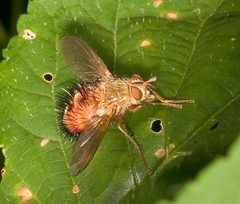
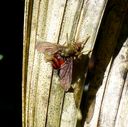
Hystricia abrupta is a of bristle fly in the Tachinidae, commonly recognized by its spiny . This large tachinid fly is frequently found in western North America, where visit late summer and fall wildflowers for nectar. Like other tachinid flies, it is a , with larvae developing inside insects. It is often mistaken for similar large tachinids such as Adejeania vexatrix and Paradejeania rutilioides due to its robust, spiny appearance.
Pronunciation
How to pronounce Hystricia abrupta: //hɪˈstrɪʃiə əˈbrʌptə//
These audio files are automatically generated. While they are not always 100% accurate, they are a good starting point.
Identification
Distinguished from Adejeania vexatrix by the absence of elongated, beak-like mouthpart palps; A. vexatrix is also slightly smaller, brighter in color, and shows a beak-like projection formed by elongated palps sheathing the mouthparts. Separated from Paradejeania rutilioides by being less robust and less spinier, with more subdued coloration; P. rutilioides is larger, more heavily spined, and tends toward more orange coloration. All three overlap in distribution and flower-visiting , requiring close examination of mouthparts and spine for reliable identification.
Images
Habitat
Forest and woodland in western North America. frequent flowering plants in late summer and fall.
Distribution
Western North America, ranging from British Columbia and Alberta south through California, Arizona, and New Mexico.
Seasonality
are active primarily in July and August; in more southerly portions of the range, activity may extend into September or October.
Host Associations
- caterpillars - Larval development occurs inside caterpillar , though specific host have not been documented.
Behavior
are regular flower visitors, taking nectar from late summer and fall wildflowers. The exhibits declining abundance toward autumn in northern portions of its range.
Ecological Role
As a of caterpillars, contributes to natural of lepidopteran . flower-visiting may provide incidental pollination services.
Human Relevance
Beneficial insect through its role in controlling caterpillar . No known negative impacts on humans.
Similar Taxa
- Adejeania vexatrixSimilar large size, spiny , and flower-visiting ; distinguished by A. vexatrix having elongated, beak-like palps, smaller size, brighter coloration, and declining autumn abundance.
- Paradejeania rutilioidesSimilar robust, spiny appearance and shared ; distinguished by P. rutilioides being larger, more heavily spined, more orange in color, and active later in the season (August–October, with stragglers into November–December).
- Macromya crocataStrongly resembles A. vexatrix and by extension H. abrupta; found in similar forested but lacks the beak-like palps of A. vexatrix.
More Details
Taxonomic notes
The Hystricia belongs to the tribe Polideini within the Tachininae. The was described by Wiedemann in 1830.
Sources and further reading
- BugGuide
- Wikipedia
- GBIF taxonomy match
- iNaturalist taxon
- NCBI Taxonomy
- Catalogue of Life
- Bug Eric: Two Spiny-butts
- A bumble bee, or not a bumble bee, that is the question: Miner bees, Anthophora abrupta — Bug of the Week
- Two Insects Lead the Fight Against Destructive Invasive Weed—But There's Still More to Be Done
- Archive — Bug of the Week