
Paradejeania rutilioides
(Jaennicke, 1867)
spiny tachina fly, hedgehog fly
Species Guides
2- Paradejeania rutilioides nigrescens(Spiny Tachinid Fly)
- Paradejeania rutilioides rutilioides(Spiny Tachinid Fly)
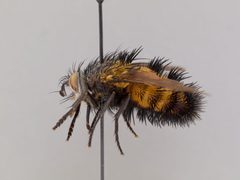
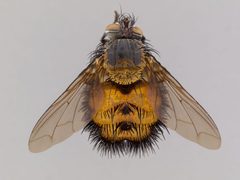
Paradejeania rutilioides is a large, robust tachinid fly known for its heavily spined . It is commonly called the "hedgehog fly" due to this distinctive appearance. are active in late summer and fall, frequently visiting flowers for nectar. The is a documented of caterpillars, specifically recorded from Edwards' Glassy-wing moth (Hemihyalea edwardsii).

Pronunciation
How to pronounce Paradejeania rutilioides: //ˌpær.əˌdɛdʒ.iˈeɪ.ni.ə ˌruː.tɪˈli.ɔɪdiːz//
These audio files are automatically generated. While they are not always 100% accurate, they are a good starting point.
Identification
Distinguished from Adejeania vexatrix by: more robust body, denser and longer abdominal spines, subdued orange color (brighter in A. vexatrix), and absence of elongated palps forming a beak-like structure. Active later in the season (August–October vs. July–August for A. vexatrix). Separated from Macromya crocata and Hystricia abrupta by greater spine and robustness.
Images
Appearance
Large, robust fly with subdued orange coloration. covered in long, prominent spines that give the its . More heavily spined and robust than related Adejeania vexatrix. Lacks the elongated, beak-like mouthpart palps seen in A. vexatrix.
Habitat
Open with late-season flowering plants. Frequently associated with rabbitbrush (Chrysothamnus/Ericameria) in western North America. Forested and semi-arid environments.
Distribution
North and Central America. Two recognized with northern and southern geographic divisions. Ranges from British Columbia and Alberta south through California, Arizona, New Mexico, and into Central America.
Seasonality
active August through October, with stragglers observed in November and December. Peak activity in late summer and autumn.
Diet
feed on nectar from flowers. Larvae are internal of caterpillars.
Host Associations
- Hemihyalea edwardsii - Edwards' Glassy-wing tiger moth, Erebidae
Life Cycle
Internal of caterpillars. Larva develops inside , eventually killing it. Specific details of -laying and not documented.
Behavior
visit flowers for nectar, particularly rabbitbrush. lifestyle contributes to of caterpillar .
Ecological Role
of caterpillars, providing natural of . flower visitation contributes to pollination services, complementing bees and other .
Human Relevance
Beneficial insect for agriculture and natural through suppression of caterpillar pest . No documented negative impacts.
Similar Taxa
- Adejeania vexatrixSimilar size, color, and flower-visiting ; distinguished by beak-like palps, brighter color, smaller size, earlier seasonality, and less robust, less spiny
- Macromya crocataResembles A. vexatrix in forested ; lacks beak-like palps but has less spiny, less robust than P. rutilioides
- Hystricia abruptaCommon mistaken for A. vexatrix; lacks extreme spine and robust build of P. rutilioides
More Details
Subspecies
Geographically divided into two , one northern and one southern
Etymology
"hedgehog fly" coined by dipterist Stephen A. Marshall, referencing the spiny