
Adejeania vexatrix
(Osten Sacken, 1877)
Orange Bristle Fly
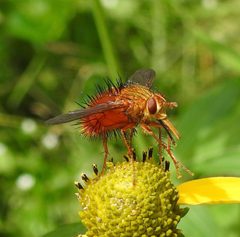
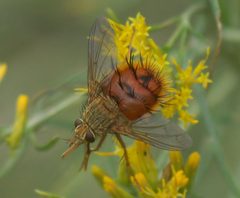
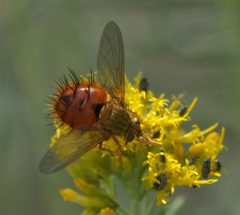
Adejeania vexatrix is a large, conspicuous tachinid fly of western North America, immediately recognizable by its bright orange , heavy black setae, and uniquely elongated palpi that project forward like a beak. are active flower visitors from mid-summer through early autumn, with persisting later in southern portions of the range. This is a known of caterpillars, though specific records remain undocumented.
Pronunciation
How to pronounce Adejeania vexatrix: //əˌdeɪˈdʒiːniə ˈvɛksətrɪks//
These audio files are automatically generated. While they are not always 100% accurate, they are a good starting point.
Identification
The elongated, forward-projecting palpi are diagnostic and immediately separate this from all similar western tachinids. Hystricia abrupta, an eastern species that resembles A. vexatrix in general coloration, lacks these elongated mouthparts entirely. Paradejeania rutilioides is more robust, spinier, and has more subdued orange coloration without the beak-like palps. Macromya crocata, found in similar forested , also lacks the elongated palpi and is slightly smaller.
Images
Appearance
Large tachinid fly with bright orange contrasting against darker . Abdomen covered with prominent, heavy black setae giving a bristly appearance. Most distinctive feature is the greatly elongated palpi that project straight forward from beneath the , forming a -like beak around the remaining mouthparts. Overall coloration slightly brighter than related .
Habitat
Open in western North America including grasslands, sagebrush steppe, and montane meadows. Frequently associated with flowering rabbitbrush (Ericameria nauseosa) and other late-summer blooming plants in ponderosa pine woodlands and pinyon-juniper zones. Observed at elevations from approximately 4500 to 8300 feet.
Distribution
Western North America from British Columbia and Alberta south through Wyoming, California, Arizona, New Mexico, and into Mexico. Core range spans the Intermountain West and southwestern United States.
Seasonality
active July through August in northern portions of range; in southern areas (Arizona, New Mexico, southern California) activity extends into September and occasionally October. Peak abundance declines toward autumn.
Host Associations
- Lepidoptera (caterpillars) - Specific undocumented; known to parasitize caterpillars but identity of prey species remains unrecorded
Life Cycle
Tachinid : females deposit or larvae on or near caterpillars; larvae penetrate host and develop internally, eventually killing the host; occurs in soil or host remains; emerge to feed on nectar and mate. Specific timing and developmental details for this unrecorded.
Behavior
are regular flower visitors, observed taking nectar from late summer and fall wildflowers particularly Ericameria nauseosa (rubber rabbitbrush). When approached, individuals frequently fly before allowing close observation or photography. activity unknown.
Ecological Role
agent; of caterpillars that helps regulate lepidopteran . flower visitation contributes to pollination services, complementing bees and other in late-season flowering .
Human Relevance
Beneficial insect providing services through caterpillar suppression and pollination. No known negative impacts. Occasionally encountered by entomologists and naturalists during late-season collecting in western North America.
Similar Taxa
- Paradejeania rutilioidesLarger, more robust body with more subdued orange coloration; more heavily spined; lacks elongated palpi; active later in season (August–December)
- Hystricia abruptaEastern North American with similar orange-and-black coloration but lacks elongated palpi entirely; distribution
- Macromya crocataSimilar forested use and general appearance but smaller, lacks elongated palpi
More Details
Etymology
The epithet 'vexatrix' is Latin for 'she who troubles or harasses,' presumably alluding to the fly's parasitic lifestyle.
Taxonomic History
Originally described as Dejeania vexatrix by Osten Sacken in 1877; later transferred to Adejeania.