
Ormia lineifrons
Sabrosky, 1953
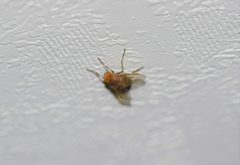
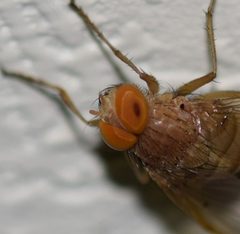
Ormia lineifrons is a multivoltine koinobiont endoparasitoid fly in the Tachinidae. It is native to the Americas and has been studied extensively in Kentucky, USA, where it parasitizes four of Neoconocephalus katydids in a sequential pattern across its three . The fly locates by eavesdropping on male mating calls, depositing first-instar larvae that develop internally and kill the host upon . Its multi-species host use creates complex evolutionary dynamics with each host species exerting different .
Pronunciation
How to pronounce Ormia lineifrons: /ˈɔr.mi.a ˈlɪ.nɛɪ.frɒns/
These audio files are automatically generated. While they are not always 100% accurate, they are a good starting point.
Images
Habitat
Field environments in temperate regions; collected within 30-mile of Murray, Kentucky, USA. katydids collected from natural vegetation between March and October. Laboratory rearing successful at 26/22°C day/night, 65-85% relative humidity, 15.5/8.5 h light/dark cycle.
Distribution
United States (Kentucky, and more broadly), Bermuda, Puerto Rico, Trinidad and Tobago, Honduras, Mexico, Nicaragua, Brazil. GBIF records confirm presence in North America.
Seasonality
Multivoltine with three per year in Kentucky: first generation active in spring (uses Neoconocephalus triops), second in summer (uses N. velox), third in late summer-fall (uses N. nebrascensis and N. robustus). collection period spans March through October.
Diet
Larvae are koinobiont endoparasitoids that develop inside living , feeding internally on host tissues and killing the host upon . diet not documented.
Host Associations
- Neoconocephalus triops - primary (first )cumulative 31.8%; pupal-to- development success significantly lower than other despite similar host size
- Neoconocephalus velox - primary (second )cumulative 72.7%; highest parasitism rate; pupal mass lowest among
- Neoconocephalus nebrascensis - primary (third )cumulative 17.5%; used concurrently with N. robustus
- Neoconocephalus robustus - primary (third )cumulative 14.3%; used concurrently with N. nebrascensis
Life Cycle
Three per year. First-instar larvae deposited on or near calling male katydids enter and develop internally for ≤10 days. Larvae emerge and pupate within hours; pupal stage lasts approximately 2 weeks. Total development from larval to fly approximately 24 days. Females take longer to develop from pupae to adults than males. observed (8% in N. triops, 25% in N. velox).
Behavior
Locates by eavesdropping on male mating calls; only male katydids are parasitized as females do not produce acoustic signals. Sequential multi- host use allows year-round . occurs when multiple larval deposition events target the same host individual.
Ecological Role
that reduces lifespan and signaling time; exerts strong on host . Participates in evolutionary arms races with multiple host simultaneously. Poor development success on Neoconocephalus triops may currently represent the strongest selective pressure driving fly evolution.