
Ormiini
Genus Guides
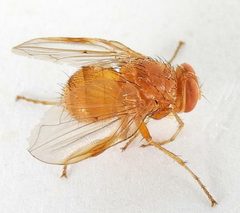
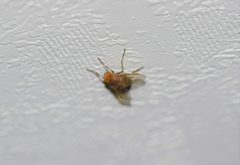
1Ormiini is a tribe of tachinid flies distinguished by their specialized acoustic hunting . Females possess a prothoracic tympanal hearing organ that enables phonotaxis toward the calling songs of orthopterans. They are of crickets and bush-crickets, depositing planidial larvae on or near hosts. The tribe includes approximately seven distributed across multiple continents.
Pronunciation
How to pronounce Ormiini: /ˌɔːrˈmiː.aɪ.naɪ/
These audio files are automatically generated. While they are not always 100% accurate, they are a good starting point.
Identification
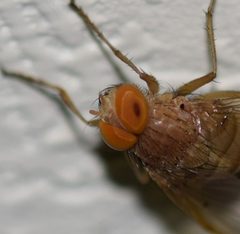
Ormiini can be distinguished from other Tachinidae by the presence of a prothoracic tympanal hearing organ located on the frontal of the prothorax, featuring paired prosternal tympanal and auditory sensory organs (bulbae acusticae). The hearing organ is sexually dimorphic: females have larger tympanal membranes, while males have larger . Old World can be differentiated by morphological characters detailed in taxonomic revisions.
Images
Distribution
Ormiini occurs on multiple continents including North America, South America, Australia, Africa, and Asia. The Homotrixa is distributed from Taiwan through southwestern Australia, with additional undescribed species in northern Western Australia, Northern Territory, Queensland, New South Wales, and Australian Capital Territory; the genus appears not to occur south of 36°S in Australia.
Diet
Ormiini have been maintained on applesauce, sugar cubes, powdered milk, and water in laboratory conditions.
Host Associations
- Gryllus spp. field crickets (principally G. rubens) - for Ormia ochracea
- Scapteriscus spp. mole crickets - for
- Acheta domesticus - less satisfactory for both
- Sciarasaga quadrata - bush , primary for Homotrixa alleni
- Mygalopsis pauperculus - for Homotrixa alleni
- Pachysaga croceopteryx - for Homotrixa alleni
Life Cycle
duration is approximately 31 days for Ormia ochracea and 36 days for , with the principal difference being time required for to complete development. In O. ochracea, emerge synchronously; in O. depleta, males precede females. Sex ratio is generally 1:1. Females deposit larvae (planidia) on or near .
Behavior
Females exhibit phonotaxis, flying to ' calling songs to locate them for . The auditory system includes a prothoracic tympanal organ with scolopidial sensory units sensitive to 4–35 kHz frequencies. Auditory show varied temporal response patterns from phasic to tonic, with some responding preferentially to low frequency sounds (~5 kHz) at high intensities (80–90 dB SPL).
Ecological Role
Ormiini function as of night-calling bushcrickets and crickets. has been released for of mole crickets.
Human Relevance
Ormiini have been used in programs, with laboratory-reared released for control of pest mole crickets. They are also studied for their specialized acoustic orientation systems.
Similar Taxa
- Other Tachinidae tribesLack the prothoracic tympanal hearing organ and phonotactic -finding characteristic of Ormiini
More Details
Laboratory rearing
Ormia ochracea and O. depleta were the first ormiines propagated in laboratory culture for at least 8 , establishing methods for maintaining these .
Sources and further reading
- BugGuide
- Wikipedia
- iNaturalist taxon
- NCBI Taxonomy
- Catalogue of Life
- Rearing phonotactic parasitoid flies [Diptera: Tachinidae, ormiini, ormia spp.]
- The tympanal hearing organ of the parasitoid fly Ormia ochracea (Diptera, Tachinidae, Ormiini)
- Hearing and frequency dependence of auditory interneurons in the parasitoid fly Homotrixa alleni (Tachinidae: Ormiini)
- Bushcricket song structure and predation by the acoustically orienting parasitoid fly Therobia leonidei (Diptera: Tachinidae: Ormiini)
- Two New Species of Homotrixa Villeneuve (Diptera: Tachinidae: Ormiini) from Southwestern Australia, With Data on Biology and Ecology
- Review of Biogeography, Host Range and Evolution of Acoustic Hunting in Ormiini (Insecta, Diptera, Tachinidae), Parasitoids of Night-calling Bushcrickets and Crickets (Insecta, Orthoptera, Ensifera)