
Leptophyes
Fieber, 1853
bush-crickets, katydids
Species Guides
1- Leptophyes punctatissima(Speckled Bush-cricket)
Leptophyes is a of bush-crickets in the Tettigoniidae, erected by Franz Xaver Fieber in 1853. Members are characterized by exceptionally long , often exceeding four times the body length, and elongated legs with tibiae twice the length of the pronotum. The genus belongs to the Phaneropterinae, a group known for involving sound production by both sexes. occur across Africa, Asia, and Europe.

Pronunciation
How to pronounce Leptophyes: //ˌlɛpˈtɒf.iˌiːz//
These audio files are automatically generated. While they are not always 100% accurate, they are a good starting point.
Identification
Distinguished from other bush- by the extreme length of relative to body size (up to four times body length) and the proportionally long tibiae. Within Phaneropterinae, identification to level requires examination of stridulatory structures and male genitalia. Similar to other Barbitistini but with more elongated appendages than many .
Images
Appearance
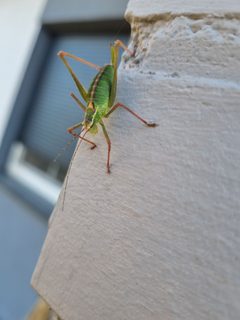
up to four times as long as the body. Legs are notably long, with tibiae twice the length of the pronotum. Body form typical of bush-crickets (Tettigoniidae) with elongated, slender build.
Distribution
Europe, Asia Minor, Palestine, Ethiopia, and Kashmir. Specific distribution varies by ; some species have restricted ranges while others are more widespread.
Seasonality
Active during summer and early autumn, based on observations of European .
Life Cycle
Hemimetabolous development with nymphs resembling miniature without fully developed wings. Specific details not documented at level.
Behavior
is well-developed, with both sexes capable of stridulation. In at least one (L. punctatissima), females respond to male calls with brief chirps, stimulating increased male calling frequency. Males move toward females during courtship, relying on female response signals. Communication effective over distances of at least 5 meters. Directional hearing sensitivity of approximately 15 dB has been demonstrated, with maximum ear sensitivity on the ipsilateral side.
Similar Taxa
- MeconemaBoth are Phaneropterinae bush-crickets with slender bodies; Meconema tend to be more and have different acoustic properties.
- TettigoniaBoth are Tettigoniidae with long , but Tettigonia are generally larger with different stridulatory mechanisms and male-female acoustic roles.
More Details
Acoustic biology
Leptophyes punctatissima has been extensively studied for its unusual system where both sexes produce sound, unlike most Tettigoniidae where only males call. Female stridulation was historically overlooked but is now recognized as essential for mate location.
Historical taxonomy
The was established by Austrian entomologist Franz Xaver Fieber in 1853, a prolific author on European Orthoptera whose work remains foundational for the group.
Sources and further reading
- BugGuide
- Wikipedia
- GBIF taxonomy match
- iNaturalist taxon
- NCBI Taxonomy
- Catalogue of Life
- What’s the difference between a cricket and a grasshopper? - Buglife Blog - Buglife
- Acoustic behaviour of both sexes of the speckled bush cricket Leptophyes punctatissima
- The directional sensitivity of a bush cricket ear: a behavioural and neurophysiological study of Leptophyes punctatissima