
Meconema
Serville, 1831
oak bush-crickets
Species Guides
2- Meconema meridionale(Southern Oak Bush-cricket)
- Meconema thalassinum(Oak Bush-cricket)
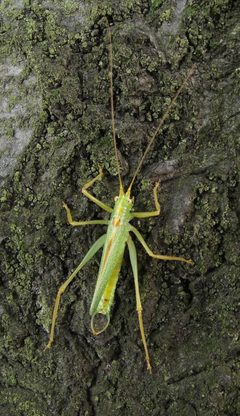
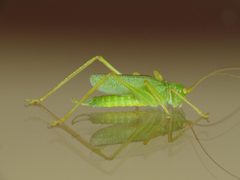
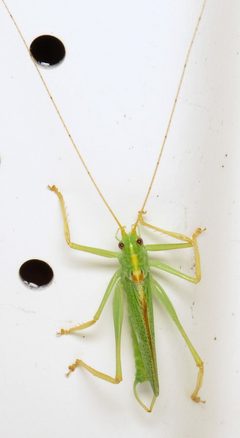
Meconema is a of small, pale green bush-crickets in the Tettigoniidae, native to Europe. The genus includes the oak bush-cricket (Meconema thalassinum), which is the only native arboreal Orthopteran in the UK, and the southern oak bush-cricket (Meconema meridionale), a more recent colonist expanding northward. Males produce sound by drumming their hind limbs against leaves rather than typical wing stridulation. Both are associated with mature trees, particularly oaks.
Pronunciation
How to pronounce Meconema: //ˌmɛkoʊˈniːmə//
These audio files are automatically generated. While they are not always 100% accurate, they are a good starting point.
Identification
From the Buglife source: Meconema are small, pale green bush-crickets with long . Meconema thalassinum has a pale cream or yellow stripe. of both sexes are fully winged. From the paper: It is the only native arboreal Orthopteran species in the UK. Males can be distinguished by their unique drumming rather than wing stridulation. Meconema meridionale (southern oak bush-cricket) is a more recent colonist expanding its range in the UK, historically restricted to southern regions.
Images
Habitat
Primarily associated with mature trees, particularly oaks (Quercus ). In the UK, Meconema thalassinum is arboreal, living in the of mature trees of various species. The southern oak bush-cricket (Meconema meridionale) has been observed in similar and is expanding into new areas including higher altitude sites.
Distribution
Native to Europe. Meconema thalassinum is widespread and common across southern and central England and south Wales in the UK, and has become established in North America over approximately the last 75 years. Meconema meridionale is expanding its range northward and westward in the UK from previous strongholds in the Thames and Humber estuaries, now reaching Derbyshire and the North York Moors. The has also been recorded in Albania, Austria, the Baltic States, Bulgaria, and Connecticut (USA).
Seasonality
present from late July through autumn.
Diet
. Meconema thalassinum feeds on a range of including Lepidopteran larvae.
Host Associations
- Lepidoptera - preylarvae as prey
- Quercus - associatedoaks, primary tree association
- mature trees - associatedvarious
Life Cycle
are laid in crevices in bark. From the paper: are present from late July to the autumn.
Behavior
. Males attract females by drumming their hind limbs on leaves, an unusual auditory method for Tettigoniidae that does not involve typical wing stridulation. This produces some of the more complex sounds for the group. From the Eric source: The drumming katydid, Meconema thalassinum, does not produce sound the way most other members of their clan do. Instead, they strike a blow against a branch, leaf, or twig to call to the opposite sex.
Ecological Role
of including Lepidopteran larvae. Arboreal contributing to dynamics in oak and other mature tree .
Human Relevance
Meconema meridionale serves as a bioindicator of climate change, with its northward and westward range expansion in the UK documented as a response to warming temperatures. Both are subjects of citizen science recording through the Grasshoppers and Related Insects Recording Scheme and the i-Record Grasshoppers app.
Similar Taxa
- XiphidiopsisJapanese formerly assigned to Meconema (Meconema subpunctatum) has been reassigned to Xiphidiopsis (X. subpunctata)
- other TettigoniidaeMost bush-crickets produce sound by wing stridulation; Meconema is distinguished by drumming using hind limbs on substrate
More Details
Genomic resources
A high-quality assembly of 9,039.1 Mb has been generated for Meconema thalassinum, scaffolded into 15 chromosomal pseudomolecules including the X , with mitochondrial genome of 15.63 kb.
Taxonomic note
Meconema is the type of the subtribe Meconematina, tribe Meconematini, and Meconematinae. The genus contains only two European ; Meconema thalassinum is the type species (originally described as Locusta varia Fabricius).
Sources and further reading
- BugGuide
- Wikipedia
- GBIF taxonomy match
- iNaturalist taxon
- NCBI Taxonomy
- Catalogue of Life
- Bug Eric: How Insects Sing
- What’s the difference between a cricket and a grasshopper? - Buglife Blog - Buglife
- The Changing Distributions of our Grasshoppers, Crickets and Relatives - Buglife Blog - Buglife
- The genome sequence of the oak bush-cricket, Meconema thalassinum (De Geer, 1773).
- Comparative Mitogenomics and Phylogenetic Implications for Nine Species of the Subfamily Meconematinae (Orthoptera: Tettigoniidae).