
Leptophyes punctatissima
(Bosc, 1792)
Speckled Bush-cricket
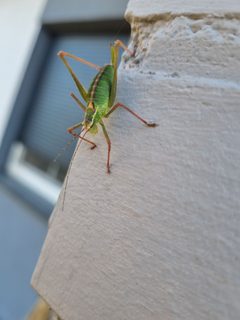
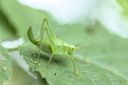
Leptophyes punctatissima, commonly known as the Speckled Bush-, is a flightless bush-cricket distributed across most of Europe. It belongs to the Phaneropterinae and exhibits distinctive acoustic where both sexes stridulate. Males produce calling songs to which females respond with brief chirps, creating a duetting communication system. The species has been studied extensively for its auditory physiology and directional hearing capabilities.

Pronunciation
How to pronounce Leptophyes punctatissima: /ˌleptəˈfaɪiːz ˌpʌŋktəˈtɪsɪmə/
These audio files are automatically generated. While they are not always 100% accurate, they are a good starting point.
Identification
Flightless; reduced wings present but non-functional for . Distinguished from similar bush-crickets by acoustic characteristics: male calling song with -specific syllable patterns, female response chirps around 40 kHz. Both sexes possess long, filamentous with more than 30 segments, typical of crickets and bush-crickets. Female possesses prominent sword-like ovipositor for -laying in vegetation.
Images
Distribution
Occurs across most of Europe. Recorded from Albania, Bulgaria, Corsica, Czech Republic (historically Czechoslovakia), and France. Widespread and common in southern UK.
Seasonality
Active throughout summer and into early autumn.
Life Cycle
Newly hatched individuals resemble miniature without wings, developing through .
Behavior
Both sexes stridulate: males produce calling songs consisting of syllable groups with distinct temporal patterns; females respond with brief chirps (~40 kHz main frequency) after male calls. Male moves toward female during courtship, dependent on her acoustic response signal. Communication effective over distances of at least 5 meters. Female response latency is -specific and functionally important for mate recognition. Directional hearing sensitivity of approximately 15 dB, with maximum sensitivity on ipsilateral side.
Similar Taxa
- Meconema thalassinumBoth are UK-native bush-crickets in Tettigoniidae with long ; differs in being almost entirely versus diet in L. punctatissima, and lacks the distinctive duetting acoustic .
- Tettigonia viridissimaBoth are UK-native bush-crickets; Great Green Bush- is larger, green in color, and has prominent ovipositor, but differs in acoustic and is not flightless.
- Conocephalus fuscusBoth are UK-native bush-crickets with prominent ovipositors; Long-winged Conehead has functional wings and different acoustic signals, and exhibits different stridulatory mechanisms.
More Details
Acoustic Communication
Unlike most Tettigoniidae where only males stridulate, both sexes of L. punctatissima produce sound. Female stridulation was previously overlooked and occurs specifically in response to male calls. The duetting system represents a derived communication strategy within Phaneropterinae.
Auditory Physiology
Studies using monaurally deafened females and auditory (T-fibre) recordings demonstrate that behavioral and neurophysiological measures of directional sensitivity yield comparable results, with approximately 15 dB overall directionality.
Sources and further reading
- BugGuide
- GBIF taxonomy match
- iNaturalist taxon
- NCBI Taxonomy
- Catalogue of Life
- What’s the difference between a cricket and a grasshopper? - Buglife Blog - Buglife
- Acoustic behaviour of both sexes of the speckled bush cricket Leptophyes punctatissima
- The directional sensitivity of a bush cricket ear: a behavioural and neurophysiological study of Leptophyes punctatissima