
Meconema thalassinum
(De Geer, 1773)
Oak Bush-cricket, Drumming Katydid
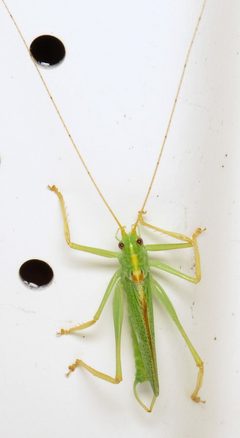
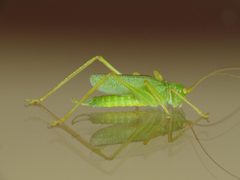
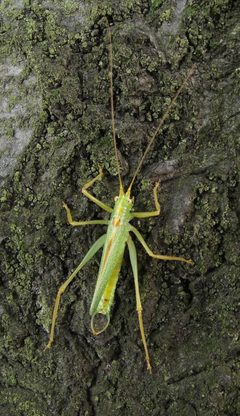
Meconema thalassinum is a small, pale green arboreal bush- in the Tettigoniidae. Native to Europe, it is the only native arboreal Orthopteran in the UK and has been introduced to North America within the last 75 years. Males attract females through a unique non-stridulatory method: drumming their hind limbs against leaves to produce vibrations. Unlike most bush-crickets, this species is , feeding on prey.
Pronunciation
How to pronounce Meconema thalassinum: /ˌmɛkoʊˈniːmə ˌθæləsˈɪnəm/
These audio files are automatically generated. While they are not always 100% accurate, they are a good starting point.
Identification
Distinguished from other European bush-crickets by its arboreal habit and unique male signaling . Separated from the related Southern Oak Bush-cricket (Meconema meridionale), which has expanded its range into the UK, by subtle morphological differences and distribution. The extremely long and pale green coloration distinguish it from grasshoppers (short antennae) and ground-dwelling crickets. The female's prominent ovipositor resembles that of the Great Green Bush- (Tettigonia viridissima) and Long-winged Conehead (Conocephalus fuscus), but M. thalassinum is smaller and exclusively arboreal.
Images
Habitat
Exclusively arboreal, inhabiting the foliage of mature trees. Strongly associated with oak trees (Quercus spp.) but also occurs on other tree . Requires mature woodland or parkland with established tree .
Distribution
Native to Europe, widespread and common across southern and central England and south Wales. Introduced to North America, first established on western Long Island and subsequently expanded to Rhode Island, Scarsdale, Stony Brook, and Ithaca, New York.
Seasonality
present from late July through autumn. Nymphs emerge in late spring and reach maturity by late summer. laid in bark crevices overwinter.
Diet
, feeding on smaller including lepidopteran larvae and caterpillars. Unlike most bush-crickets, does not consume plant material.
Life Cycle
laid singly in crevices under tree bark. Nymphs emerge in late spring, developing through several instars. reach maturity by late summer and persist into autumn. stage is the egg.
Behavior
. Males produce -specific signals to attract females by drumming their hind limbs against leaves, creating substrate-borne vibrations. This drumming replaces the stridulatory sound production typical of most Tettigoniidae. The resulting vibrations are transmitted through the leaf and are among the more complex acoustic signals produced by this group. Both sexes occupy tree foliage, where they hunt prey.
Ecological Role
of foliar , particularly caterpillars and other soft-bodied larvae. Serves as for the parasitic Spinochordodes tellinii, which manipulates host to facilitate its own aquatic .
Human Relevance
Subject of scientific interest due to its unique system and status as the first sequenced in Tettigoniidae. Range expansion in North America provides case study in invasion .
Similar Taxa
- Meconema meridionaleSouthern Oak Bush-cricket; recently expanded range into UK from continental Europe; similar arboreal habit and but distinct
- Tettigonia viridissimaGreat Green Bush-; much larger with similarly prominent female ovipositor but stridulatory calling song and diet
- Conocephalus fuscusLong-winged Conehead; shares prominent female ovipositor but ground-dwelling or shrub-layer and stridulatory song production
- Leptophyes punctatissimaSpeckled Bush-cricket; small green bush- but with shorter and stridulatory song
Sources and further reading
- BugGuide
- Wikipedia
- GBIF taxonomy match
- iNaturalist taxon
- NCBI Taxonomy
- Catalogue of Life
- Bug Eric: How Insects Sing
- What’s the difference between a cricket and a grasshopper? - Buglife Blog - Buglife
- I Brake for Dung Beetles! | Beetles In The Bush
- The Changing Distributions of our Grasshoppers, Crickets and Relatives - Buglife Blog - Buglife
- behavior | Beetles In The Bush | Page 6
- Scarabaeidae | Beetles In The Bush | Page 4
- The genome sequence of the oak bush-cricket, Meconema thalassinum (De Geer, 1773).