
Ormia
Robineau-Desvoidy, 1830
Species Guides
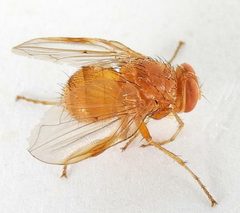
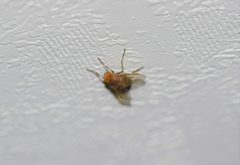
5Ormia is a of tachinid flies renowned for their exceptional sound localization abilities. Females are phonotactic that locate by detecting calling songs, then deposit larvae on or near crickets and katydids. The genus has become a model system in auditory neuroscience and bioinspired engineering due to its mechanically coupled ears that achieve directional rivaling human hearing despite minute interaural distances. Research has focused primarily on Ormia ochracea, though multiple have been studied for applications.
Pronunciation
How to pronounce Ormia: /ˈɔr.mi.a/
These audio files are automatically generated. While they are not always 100% accurate, they are a good starting point.
Identification
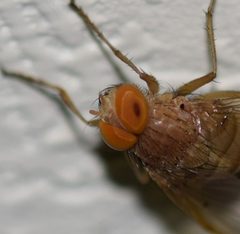
Ormia are distinguished from other tachinid flies by their specialized auditory anatomy: paired tympanal located on the near the bases of the front legs, physically coupled by a cuticular bridge. This structure is visible externally as a small, pale region on the prothorax. The ears are sexually in structure but functionally dimorphic, with females exhibiting stronger phonotactic responses. Species-level identification requires examination of genitalia and bristle patterns; Ormia ochracea is the most widespread and frequently encountered species in collections.
Images
Distribution
The occurs across the Americas, with individual showing distinct ranges. Ormia ochracea is widespread in North America, Central America, and the Caribbean. is native to South America and has been established in central and southern Florida following intentional introduction for . Multiple species are to Brazil, described by Tavares in the 1960s. The exact distributions of many species remain poorly documented.
Seasonality
Activity patterns are tied to availability and calling . are and most active during periods when host crickets and katydids produce calling songs. In temperate regions, activity peaks during summer months; in subtropical and tropical regions, activity likely extends across warmer seasons. Laboratory colonies of O. ochracea and O. depleta maintained continuous with of approximately 31 and 36 days respectively.
Diet
feed on liquids including applesauce, sugar, and powdered milk solutions in laboratory conditions. Natural adult diet is presumed to include nectar and other sources, though specific documentation is lacking. Larvae are obligate developing internally on tissues.
Host Associations
- Gryllidae (crickets) - Primary for O. ochracea; females deposit on or near singing males
- Gryllotalpidae (mole crickets) - for O. depleta, specifically Neoscapteriscus
- Tettigoniidae (katydids) - for O. lineifrons, including multiple Neoconocephalus used sequentially across
Life Cycle
Females deposit first-instar larvae () on or near after phonotactic location. Larvae penetrate host and develop internally as endoparasitoids. Development from deposition to requires approximately 31 days in O. ochracea and 36 days in O. depleta under laboratory conditions at 25°C. The principal difference between is planidia development time. occurs within the host remains or in soil. Adults are short-lived; females live slightly longer than males. Sex ratio is approximately 1:1. In O. ochracea, adults emerge synchronously, while in O. depleta males precede females.
Behavior
Females exhibit strong positive phonotaxis to calling songs, with behavioral thresholds near 40 dB SPL at 4.5–5.2 kHz for O. ochracea. Sound localization reaches approximately 2° in azimuth, achieved through mechanical coupling of tympanal that amplifies interaural time and level differences. Individual flies show consistent, repeatable differences in approach latency, path straightness, and phonotactic threshold. Flies can learn to associate non-acoustic cues (light) with host presence and retain this association for at least 24 hours. is bimodal with most individuals moving only short distances (1 cm) and a smaller proportion dispersing farther (10 cm); no innate directional orientation to sound or light has been demonstrated in larvae.
Ecological Role
Ormia function as regulating of singing Orthoptera. O. depleta has been deployed as a agent against pest mole crickets (Neoscapteriscus) in Florida, where it is now established in most counties. The represents a case of acoustic exploitation in , with parasitoids imposing selection pressure on signaling .
Human Relevance
Ormia ochracea serves as a premier model organism in auditory neuroscience and bioinspired engineering. Its hearing mechanism has inspired multiple of directional microphone designs, hearing aid technologies, and array algorithms. The fly's ability to localize sound with far exceeding conventional acoustic limits has been extensively studied for biomimetic applications. O. depleta has been intentionally released for of mole crickets in the United States.
Similar Taxa
- Other Ormiini genera (Euphasiopteryx, Myiophasiopteryx)Share tachinid lifestyle and some exhibit phonotaxis, but lack the specialized prosternal ear with mechanically coupled that defines Ormia; identification requires dissection of auditory structures
- Homoeoxiphia (conopid flies)Also of singing Orthoptera with phonotactic , but belong to Conopidae with different and larval development mode; ears are located on different body segments
More Details
Auditory mechanism
The tympanal organ consists of two thin cuticular on the connected by a cuticular bridge. Sound induces rocking motion of this structure, mechanically amplifying interaural differences that would otherwise be below the threshold for neural detection. Recent 3D reconstructions reveal curved lateral on the tympanal organ not captured in earlier models, requiring updated biomechanical models with spatially-varying spring and damper coefficients for accurate prediction of responses across all incident angles.
Research significance
The Ormia ear has inspired technologies including MEMS microphones, hearing aid directional arrays, and radar/sonar processing algorithms. The 2021 quasi-two-dimensional model improved angular from ±30° to full 360° coverage, with average errors below 10%.
Sources and further reading
- BugGuide
- Wikipedia
- GBIF taxonomy match
- NCBI Taxonomy
- Catalogue of Life
- Rearing phonotactic parasitoid flies [Diptera: Tachinidae, ormiini, ormia spp.]
- Brazilian Red-Eyed Fly Ormia depleta (Wiedemann) (Diptera: Tachinidae)
- Individual consistency, learning and memory in a parasitoid fly, Ormia ochracea
- Cues for Directional Hearing in the Fly Ormia ochracea
- Multi-Species Host Use by the Parasitoid Fly Ormia lineifrons
- Larval dispersion of Ormia depleta (Towns.) (Dipt., Tachinidae)
- Auditory priming as a means to study attention in the acoustic parasitoid fly, Ormia ochracea
- Study on Bionic Principles of the Parasitoid Fly Ormia Ochracea for Sound Source Localization
- A biologically accurate model of directional hearing in the parasitoid fly Ormia ochracea
- Biologically-inspired antenna arrays based on the hearing mechanism of the parasitoid fly Ormia Ochracea
- Optical Sensing Inadirectional Memsmicrophone Inspired by the Ears of the Parasitoid Fly, Ormia Ochracea
- A High-Precision Algorithm for DOA Estimation Using a Long-Baseline Array Based on the Hearing Mechanism of the Ormia Ochracea
- Acoustic attraction of the parasitoid fly Ormia ochracea to the song of its host
- Hosts of a Phonotactic Parasitoid and Levels of Parasitism (Diptera: Tachinidae: Ormia ochracea)
- The tympanal hearing organ of the parasitoid fly Ormia ochracea (Diptera, Tachinidae, Ormiini)