
Neoconocephalus triops
(Linnaeus, 1758)
Broad-tipped Conehead
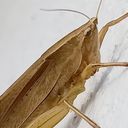
Neoconocephalus triops, commonly known as the broad-tipped conehead, is a large in the Tettigoniidae. It has a wide geographic distribution spanning from Peru to Ohio, USA, including the Caribbean and North America. Females use male pulse rate and call structure for mate recognition, with documented geographic variation in signal preferences between . Puerto Rican females show high selectivity for pulse rate but not call structure, while Rican females prefer versed calls and show temperature-dependent selectivity for pulse rate.


Pronunciation
How to pronounce Neoconocephalus triops: /ˌniːoʊˌkɒnəˈsɛfələs ˈtraɪˌɒps/
These audio files are automatically generated. While they are not always 100% accurate, they are a good starting point.
Images
Habitat
Tropical environments; laboratory studies indicate of 50-70% relative humidity and temperature ranges of 20-30°C. Natural experience year-round breeding in tropical regions.
Distribution
Wide distribution from Peru, South America to Ohio, USA. Documented in Caribbean, Mexico, and southeastern United States including Alabama, Arizona, and Arkansas. Study confirmed from Liberia, Rica and Naguabo, Puerto Rico.
Seasonality
Multivoltine (year-round breeding) in tropical environments; in temperate environments with different calls per corresponding to differing daylengths.
Life Cycle
Females deposit in grass. Multivoltine in tropics with continuous breeding; in temperate zones. Rapid development typical of the .
Behavior
Females exhibit phonotaxis toward male mating calls. Call recognition is based on double-pulse rate rather than actual double-pulse structure. Geographic variation in female preferences documented: Puerto Rican females have closed preference functions for pulse rate at both 20°C and 25°C, indicating high selectivity; Rican females show closed preference only at 20°C, becoming unselective toward higher than natural pulse rates at 25°C. Costa Rican females prefer versed calls over continuous calls, while Puerto Rican females show no selectivity for call structure.
More Details
Communication System Evolution
Reduced selectivity for call structure or pulse rate in some allows calls to display necessary variation for communication system evolution. Temperature coupling of preferences and signals is typical for insects in this .
Sources and further reading
- BugGuide
- Wikipedia
- GBIF taxonomy match
- iNaturalist taxon
- NCBI Taxonomy
- Catalogue of Life
- Ten Facts You May Not Know About Tadpole Shrimp | Bug Squad
- Begone Tadpole Shrimps! They're 'Time Travelers' in Rice Fields | Bug Squad
- Outstanding Group of UC Davis Graduate Students at ESA Meeting | Bug Squad
- Visitors Marvel at Tadpole Shrimp at Bohart Museum Open House | Bug Squad
- Just Add Water - Buglife Blog - Buglife
- Bug Eric: Orthoptera Thursday: The Katydid's Menu
- Geographic Variation in Signal Preferences in the Tropical Katydid Neoconocephalus triops
- Broad-Tipped Conehead Katydid (suggested common name) Neoconocephalus triops (Linnaeus, 1758) (Orthoptera: Tettigoniidae: Conocephalinae)