
Psorophora howardii
Coquillett, 1901
Howard's Gallinipper
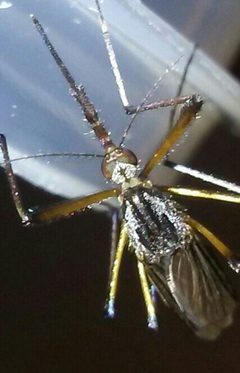
Psorophora howardii is a large, aggressive floodwater mosquito native to tropical and subtropical regions of the Americas. The was described by Daniel William Coquillett in 1901. females are persistent biters that attack humans and medium to large mammals at any time of day, with a strong enough to pierce through multiple layers of clothing. Larvae are , feeding on other mosquito larvae in temporary aquatic . The species has demonstrated recent northward range expansion, with the first Canadian record documented in 2024 in southern Ontario.

Pronunciation
How to pronounce Psorophora howardii: //sɔːˈrɒfəˌra haʊˈwɑːrdii//
These audio files are automatically generated. While they are not always 100% accurate, they are a good starting point.
Identification
Distinguished from other Psorophora by combination of large size, shaggy legs, and specific patterns: broad grayish-white scales with bare stripe, dark , and white abdominal median patch. and palpi proportions also diagnostic. of COI gene can confirm morphological identification.
Images
Habitat
Floodwater including rain pools, grassy ditches, woodland pools, and agricultural depressions prone to flooding. In Florida, documented in citrus furrow irrigation systems where females oviposit low in furrows. Larvae occur in unshaded or partly shaded temporary rain-filled pools.
Distribution
Native to tropical and subtropical Americas: southern United States, Mexico, Caribbean Islands, Central America ( Rica, El Salvador, Guatemala, Nicaragua), and South America (Brazil, Cuba, Lesser Antilles). Previous northern limit approximately 40.5°N (central Indiana). Recent northward expansion documented in Pennsylvania (~40.6°N), New York (~40.9°N), Iowa (~41.6°N), and first Canadian record in Windsor-Essex County, Ontario (~42.2–42.3°N) in September 2024.
Seasonality
Larvae occur from March to October. active year-round in southern range; seasonal in northern expanded range.
Diet
Larvae are , feeding on other mosquito larvae. females are aggressive blood-feeders on medium to large mammals including humans.
Host Associations
- humans - blood-feeding persistent biter, attacks at any time of day
- medium to large mammals - blood-feeding
Life Cycle
Floodwater mosquito; females oviposit in dirt depressions prone to flooding. hatch following rainfall or irrigation flooding. development occurs in temporary aquatic . Larval stage .
Behavior
females are notoriously aggressive blood-feeders that readily attack humans. Persistent biters active at any time of day. capable of piercing multiple layers of clothing including coat, vest, and two shirts. Larvae are predatory, capturing prey through rapid neck extension to launch toward prey—a fixed-action pattern strike taking approximately 15 milliseconds.
Ecological Role
Human Relevance
Significant nuisance pest due to aggressive biting and ability to pierce clothing. Potential ; noted as capable of spreading West Nile virus, though specific vector competence studies for this remain unstudied. Range expansion into new regions may increase human exposure.
Similar Taxa
- Psorophora ciliataBoth are large predatory floodwater mosquitoes with aggressive biting ; P. ciliata distinguished by different patterns and distribution more common in eastern United States
- Psorophora feroxBoth are floodwater Psorophora with recent northward range expansion; P. ferox has different abdominal patterns and slightly smaller size
- Aedes vexansShares floodwater and aggressive biting ; distinguished by smaller size, different larval strategy (non- or facultative), and lack of shaggy leg scaling
More Details
Range expansion mechanism
Northward expansion into Canada and northern United States likely facilitated by human-aided through highways and shipping routes, combined with warming climate patterns that extend suitable northward. Multiple detection locations in Ontario suggest potentially established , though capability in Canada remains unknown.
Research gaps
competence for specific and field rates remain unstudied. Predatory larval inferred from congeneric P. ciliata studies using high-speed videography, but not directly documented for P. howardii.
Sources and further reading
- BugGuide
- Wikipedia
- GBIF taxonomy match
- iNaturalist taxon
- NCBI Taxonomy
- Catalogue of Life
- Harpoon Heads, Sweeping Tails: How Predatory Mosquito Larvae Capture Prey
- Mosquito Management in the Era of Extreme Weather
- The Best of 2022 on Entomology Today
- New record of Psorophora howardii (Diptera: Culicidae) in Southern Ontario, Canada.