
Embaphion
Say, 1824
Species Guides
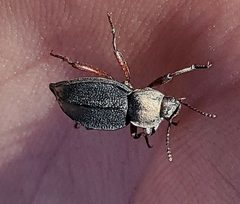
7Embaphion is a of darkling beetles in the Tenebrionidae, first described by Thomas Say in 1824. The genus contains eight recognized distributed primarily in North America, with a center of diversity in the southwestern United States and adjacent Mexico. Species within this genus are characterized by their distinctive explanate (flared or expanded) that give them a flattened, shield-like appearance. Embaphion species are primarily and frequently encountered in arid and semi-arid , particularly sand dune where several species appear to be habitat .


Pronunciation
How to pronounce Embaphion: /ɛmˈbeɪfiən/
These audio files are automatically generated. While they are not always 100% accurate, they are a good starting point.
Identification
The strongly explanate (flared) that are distinctly wider than the pronotum and create a flattened, disc-like body profile are diagnostic for this within Tenebrionidae. This separates Embaphion from the more cylindrical Eleodes and other darkling beetles with which it co-occurs. The genus can be distinguished from superficially similar ground beetles (Carabidae) by the bead-like () (versus in Carabidae) and concealed (versus exposed, forward-directed mandibles in Carabidae). -level identification requires examination of specific characters such as elytral (smooth versus muricate), body proportions, and geographic distribution.
Images
Habitat
Primarily associated with arid and semi-arid environments. Embaphion muricatum has been documented in sand dune in southeastern New Mexico. The appears to show particular affinity for sandy substrates, with multiple observations from dune systems and sandy grasslands. Some occur in juniper/oak/pinyon woodland with sandy soils.
Distribution
North America, with primary distribution in the southwestern United States (New Mexico, Oklahoma, Texas, Arizona, Utah, Nevada, Kansas) and adjacent northern Mexico. The extends northward into the Great Plains. Specific distributions vary: Embaphion muricatum occurs in New Mexico and Oklahoma; Embaphion glabrum has been recorded from Utah; Embaphion depressum and Embaphion muricatum have broader distributions; Embaphion mexicanum is restricted to Mexico.
Seasonality
activity appears to peak in late summer and early fall (September). Multiple observations of Embaphion muricatum were made in mid-September in New Mexico. activity is common, with specimens frequently encountered at night under artificial light sources.
Behavior
Primarily . Embaphion muricatum has been observed crawling on sand dunes and sandy ground at night, and is attracted to mercury-vapor lights. Activity appears to increase after sunset, with specimens becoming more visible on the surface of sand dunes during nighttime hours. During daylight hours, individuals likely shelter beneath vegetation or in sand. Movement is described as slow and deliberate, typical of many darkling beetles that rely on chemical defense and heavy rather than rapid escape.
Ecological Role
As or omnivores typical of Tenebrionidae, likely contribute to nutrient cycling in arid . Their association with sand dune suggests they may play a role in the of these specialized ecosystems. activity and attraction to light sources indicates they serve as prey for nocturnal including birds, bats, and .
Human Relevance
Of interest to entomologists and naturalists due to distinctive . No significant economic importance documented. Not known to be agricultural pests or beneficial . Attraction to artificial light sources makes them occasional subjects of insect surveys.
Similar Taxa
- EleodesBoth are darkling beetles (Tenebrionidae) occurring in similar arid . Eleodes are more cylindrical with parallel-sided that are not explanate, and many exhibit the characteristic '-standing' defensive posture. Embaphion lacks this and has distinctly flared, flattened elytra.
- PhilolithusAnother tenebrionid with heavy-bodied, slow-moving beetles found in arid western North America. Philolithus have more convex, cylindrical bodies without the explanate of Embaphion.
- EusattusDarkling beetles in sand dune . Eusattus are more streamlined and adapted for burrowing in sand, with cylindrical bodies and legs, unlike the flattened, disc-like Embaphion.
- ZopherusFormerly placed in Tenebrionidae, these 'ironclad beetles' have extremely hard, sculptured . They are found on tree trunks at night rather than on sand, and lack the explanate of Embaphion.
More Details
Taxonomic History
The was established by Thomas Say in 1824. Eight are currently recognized, with most described in the late 19th and early 20th centuries. The genus has remained relatively stable taxonomically, though species-level boundaries may warrant further study.
Etymology
The name Embaphion is of Greek derivation, likely referring to the distinctive body form or associations, though the precise etymology is not well-documented in readily available sources.
Species Diversity
The eight recognized show variation in elytral (smooth versus muricate), body proportions, and geographic distribution. Embaphion muricatum (Say, 1824) is the type species and among the most frequently encountered in collections.