
Embaphion muricatum
Say, 1824
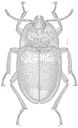
Embaphion muricatum is a darkling beetle in the Tenebrionidae. The is characterized by a notably explanate, or flattened and expanded, body form that gives it a distinctive appearance among tenebrionids. It has been documented from sand dune in the southwestern United States and from prairie regions in Canada. Observations indicate it is active during late summer and early fall, with frequently encountered at night.
Pronunciation
How to pronounce Embaphion muricatum: /ɛmˈbeɪfiˌɒn mjʊˈrɪkəˌtʌm/
These audio files are automatically generated. While they are not always 100% accurate, they are a good starting point.
Identification
The explanate body form—flattened and laterally expanded—is diagnostic and readily separates Embaphion muricatum from sympatric darkling beetles. It can be distinguished from Eleodes , which are more cylindrical and elongate, and from other tenebrionids by its broad, plate-like silhouette. In sand dune , it may occur alongside other darkling beetles but is immediately recognizable by its flattened profile.
Images
Habitat
Sand dune in the southwestern United States; also recorded from prairie and grassland regions in Canada. In New Mexico, specifically associated with active sand dunes and sandy substrates. activity pattern suggests to arid environments where nighttime conditions reduce desiccation risk.
Distribution
Recorded from Alberta and Saskatchewan in Canada; Mexico; and the southwestern United States including New Mexico. Specific localities include sand dune systems in southeastern New Mexico.
Seasonality
active in late summer and early fall. Field observations from September in New Mexico document active adults. Seasonal timing coincides with post-monsoon conditions in the southwestern United States.
Behavior
. have been observed on sand surfaces at night. Frequently attracted to artificial light sources, including mercury-vapor lights. In sand dune , occurs in numbers and diversity alongside other nocturnal tenebrionids.
Ecological Role
Contributes to in sand dune . As a or scavenger, likely participates in nutrient cycling in arid environments, though specific ecological functions have not been documented.
Human Relevance
Of interest to entomologists and collectors due to its distinctive . Not known to be economically significant or pestiferous.
Similar Taxa
- Eleodes speciesSympatric darkling beetles in the same but with cylindrical, elongate bodies rather than the explanate form of Embaphion muricatum.
- Eusattus reticulatusAnother tenebrionid occurring in sandy of the southwestern United States, but with different body proportions and surface sculpturing.
More Details
Field observations
Described as 'favorites' by field observers due to the distinctive explanate . At Mescalero Sands, New Mexico, noted as 'as common as I've ever seen them' during September surveys. Multiple individuals frequently encountered under mercury-vapor lights in sand dune .
Taxonomic note
The Embaphion contains few , and E. muricatum is the most widely documented. The explanate body form is characteristic of the genus.