
Eusattus reticulatus
(Say, 1824)
Sand Darkling Beetle
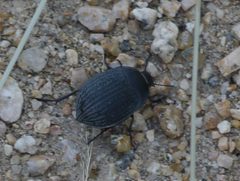
Eusattus reticulatus is a of darkling beetle in the Tenebrionidae, commonly known as the sand darkling beetle. It inhabits sandy environments in southwestern North America. The species is primarily ground-dwelling and has been observed in association with juniper-oak-pinyon woodland on sandstone escarpments. Like other members of the , it is adapted to arid and semi-arid conditions.
Pronunciation
How to pronounce Eusattus reticulatus: /juːˈsætəs rɪˌtɪkjʊˈlɑːtəs/
These audio files are automatically generated. While they are not always 100% accurate, they are a good starting point.
Identification
Eusattus reticulatus can be distinguished from similar darkling beetles by its association with sandy substrates and its distribution in the southwestern United States and Mexico. The specific epithet "reticulatus" suggests a reticulated or net-like surface pattern, though detailed diagnostic features require examination of specimens. Separation from congeneric requires comparison of elytral , body proportions, and male genitalia.
Images
Habitat
Sandy environments including sand dunes and sandy soils in arid and semi-arid regions. Documented from juniper-oak-pinyon woodland on sandstone escarpments with sandy substrate.
Distribution
Southwestern United States (New Mexico, Arizona, Texas) and Mexico. Documented in the field report from Quay County, New Mexico, and distribution records indicate presence in Mexico.
Seasonality
activity observed in September in New Mexico, suggesting late summer to fall activity period.
Behavior
Ground-dwelling; observed crawling on the ground in daylight. activity patterns unknown but inferred from -level traits of many tenebrionids.
Ecological Role
Contributes to nutrient cycling in sandy arid through detritivory and decomposition processes typical of darkling beetles.
Similar Taxa
- Eusattus muricatusCongeneric with overlapping distribution; requires examination of elytral and body form for separation
- Other Eleodes speciesSympatric darkling beetles in similar ; Eleodes generally larger with more robust body form and different antennal structure
- Embaphion muricatumSympatric sand-dwelling tenebrionid with explanate (flattened and extended) elytral margins, a distinctive feature not present in Eusattus
More Details
Field observation notes
The only direct field observation in the provided source describes a single individual "crawling on the ground" in juniper/oak/pinyon woodland on a sandstone escarpment at "San Jon Hill" in Quay County, New Mexico, on September 10, 2024. The observer noted little other insect activity at the time despite abundant flowering plants.