
Eleodes obscura
(Say, 1824)
Obscure Darkling Beetle
Species Guides
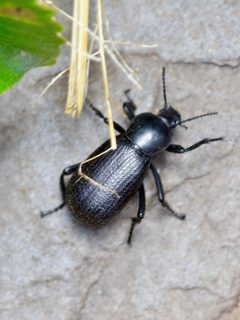
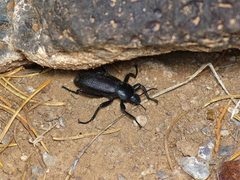
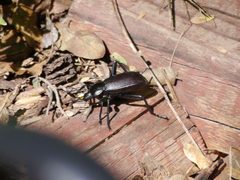
4Eleodes obscura is a large darkling beetle in the Eleodes, native to western North America. measure 23–31 mm in length and are characterized by dull black coloration with grooved . The species occupies a broad geographic range extending from south-central British Columbia to northern Mexico and eastward to the Great Plains. It is primarily and has been observed climbing tree trunks at night.
Pronunciation
How to pronounce Eleodes obscura: //ɛl.iˈoʊ.dɪz əbˈskjʊ.rə//
These audio files are automatically generated. While they are not always 100% accurate, they are a good starting point.
Identification
Distinguished from other Eleodes by combination of large size (23–31 mm), dull black coloration, grooved , and presence of tooth on front . The pronotum lacks the forward-projecting corners seen in some . E. o. sulcipennis has been recognized based on elytral differences. Separated from E. suturalis by lack of contrasting reddish or lighter elytral margins.
Images
Habitat
Occupies diverse across western North America including coniferous forests, woodlands, and adjacent open areas. Frequently associated with Pinus ponderosa (Ponderosa pine) and Juniperus osteosperma (Utah juniper) in montane and canyon environments. Found from low desert elevations to alpine zones above 7000 feet.
Distribution
Western North America from south-central British Columbia, eastern Washington and Oregon, south to northern Mexico, and east to Nebraska, Kansas, and Texas.
Seasonality
active from late spring through fall, with peak activity in summer months. activity observed on warm nights. E. o. sulcipennis recorded in September in southwestern Utah.
Diet
. Consumes dead plant material, animal remains, roots, and seeds.
Behavior
Nocturnally active, climbing tree trunks of conifers and junipers at night. Has been observed on trunks of Pinus ponderosa and Juniperus osteosperma. may be found on ground at base of trees. Defensive posture assumed when disturbed, characteristic of the Eleodes.
Ecological Role
Decomposer and , contributing to nutrient cycling through consumption of dead organic matter. Serves as prey for in forest and woodland .
Human Relevance
Occasionally kept as a pet due to hardiness and low maintenance requirements, similar to other Eleodes . No significant agricultural or economic impact documented.
Similar Taxa
- Eleodes suturalisSimilar large size and general form, but E. suturalis has contrasting reddish or lighter-colored elytral margins and different pronotal structure.
- Eleodes hispilabrisOverlapping range and , but differs in elytral and leg armature.
- Coelocnemis sulcataSympatric tenebrionid found on same tree trunks, but distinguished by different body form and elytral striation pattern.
More Details
Subspecies
Eleodes obscura sulcipennis has been recognized as a , distinguished by more deeply sulcate . Recorded from southwestern Utah in montane coniferous forest.
Collection method
Effectively collected by searching tree trunks at night with headlamp, particularly Ponderosa pine and Utah juniper in appropriate . Bottle traps with sweet baits may also capture specimens.