
Eleodes obscura sulcipennis
Mannerheim, 1843
Eleodes obscura sulcipennis is a of darkling beetle in the Tenebrionidae. It has been documented in coniferous woodland of southwestern Utah, where are active on the trunks of Ponderosa pine and Utah juniper at night. The subspecies was described by Mannerheim in 1843 and is currently accepted as valid.
Pronunciation
How to pronounce Eleodes obscura sulcipennis: //ɛˈliː.oʊˌdiːz ɔbˈskjʊərə sʌlˈsɪpɛnɪs//
These audio files are automatically generated. While they are not always 100% accurate, they are a good starting point.
Identification
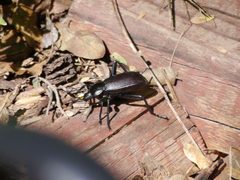
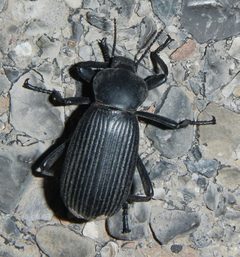
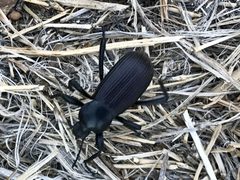
This can be distinguished from other Eleodes obscura subspecies by the presence of pronounced longitudinal (grooves) on the , as indicated by the subspecific epithet 'sulcipennis'. are medium-sized darkling beetles with the typical elongate body form characteristic of the Eleodes.
Images
Habitat
Coniferous woodlands dominated by Pinus ponderosa (Ponderosa pine) and Juniperus osteosperma (Utah juniper) in montane regions. Observed at elevations around 6000 feet in southwestern Utah.
Distribution
Documented from southwestern Utah (Kane County, Ponderosa Grove Campground area). The broader Eleodes obscura occurs across western North America; this ' precise range boundaries remain poorly documented.
Seasonality
have been observed in early September, suggesting late-season activity in montane .
Host Associations
- Pinus ponderosa - observed on trunk at night
- Juniperus osteosperma - observed on trunk at night
Behavior
are and climb on the trunks of large coniferous trees at night. They have been observed active on tree trunks during post-dusk hours in early September.
Similar Taxa
- Coelocnemis sulcataSympatric tenebrionid found on same tree trunks at night; distinguished by different -level and presumably different elytral sculpturing patterns.
- Eleodes pimelioidesSympatric found in same general region; distinguished by different body form and use (ground-dwelling in pine duff versus trunk-climbing).
More Details
Taxonomic note
Originally described as Eleodes sulcipennis by Mannerheim in 1843, currently treated as a of Eleodes obscura. The basionym Eleodes sulcipennis reflects the diagnostic grooved (sulcate) .
Field observation context
Specimens were encountered during targeted nighttime surveys for tenebrionid beetles on conifer trunks, a sampling method effective for detecting darkling beetles in montane .