
Eleodes hirsuta
LeConte, 1861
Hairy Stink Beetle, Hairy Eleodes
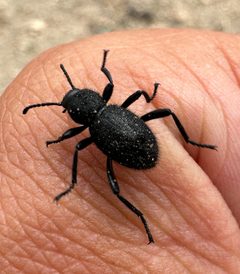
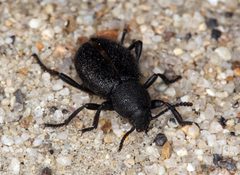
Eleodes hirsuta is a large darkling beetle (Tenebrionidae) native to western North America, recognized by its conspicuously hairy body and defensive chemical-secreting . The belongs to the 'clown beetle' group, known for their characteristic -stand posture when threatened. are primarily and active during warmer months in arid and semi-arid grassland .
Pronunciation
How to pronounce Eleodes hirsuta: /ɛˈliːoʊdiːz hɜrˈsuːtə/
These audio files are automatically generated. While they are not always 100% accurate, they are a good starting point.
Identification
Eleodes hirsuta is distinguished from by its densely setose (hairy) body covering, which gives the its name. The is large-bodied, typically exceeding 25 mm in length. The pronotum is broadly explanate (spread outward flatly) with upturned lateral margins. are distinctly flattened with sharply laterally carinate (keeled) edges. Coloration is predominantly black with a variable reddish-brown sutural stripe running lengthwise along the elytral . The combination of hairy , keeled elytra, and explanate pronotum separates this species from the similar E. suturalis and E. hispilabris, which lack the dense hair covering.
Images
Habitat
Arid and semi-arid mixed-grass prairies, shortgrass plains, and desert grasslands. Found in sandy to loamy soils where it burrows readily.
Distribution
Western North America, including the Great Plains region. Documented from Oklahoma, Kansas, South Dakota, and New Mexico. The ' range overlaps broadly with that of E. suturalis and E. acuta in the central Great Plains.
Seasonality
are active during warmer months, with peak activity in mid-summer (July). activity pattern.
Behavior
When threatened, performs the characteristic '-stand' defensive posture of Eleodes, raising the and directing the surface toward the perceived threat while secreting defensive chemicals from abdominal glands. Primarily . Burrows actively in soil.
Ecological Role
A that contributes to nutrient cycling in grassland . Its activity and burrowing influence soil structure and organic matter decomposition.
Human Relevance
Occasionally kept as a low-maintenance pet due to its hardiness and long lifespan in captivity. Of scientific interest for its defensive chemistry and as a subject for behavioral observation.
Similar Taxa
- Eleodes suturalisNearly identical in size, coloration (black with reddish sutural stripe), and , but E. suturalis lacks the dense hair covering and has less sharply carinate . E. hirsuta has a more broadly explanate pronotum with upturned rather than rounded lateral margins.
- Eleodes hispilabrisSimilar size and color pattern, but E. hispilabris lacks the dense body hair and has different pronotal shape; historically confused with E. hirsuta due to convergent coloration.
- Eleodes acutaOccurs sympatrically with similar reddish sutural stripe, but E. acuta averages larger (around 30 mm vs. under 26 mm for E. hirsuta) and has rounded rather than upturned pronotal lateral margins; lacks the dense hair covering.