
Polyphylla occidentalis
(Linnaeus, 1767)
Western Ten-lined June Beetle, Western Lined June Beetle
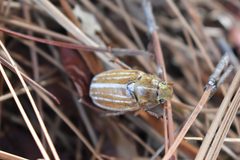
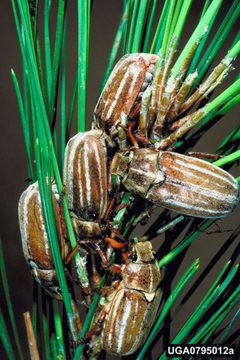
Polyphylla occidentalis is a scarab beetle in the Scarabaeidae, commonly known as the western ten-lined or western lined June beetle. It is native to the southeastern United States, where are active during warm summer months. The is characterized by brownish coloration with white longitudinal stripes and enlarged, fan-like in males that function in detecting female . Larvae develop underground, feeding on plant roots.
Pronunciation
How to pronounce Polyphylla occidentalis: //ˌpɒlɪˈfɪlə ˌɒksɪdɛnˈteɪlɪs//
These audio files are automatically generated. While they are not always 100% accurate, they are a good starting point.
Identification
Males are readily identified by their conspicuously enlarged, that can be held splayed open; these are substantially larger than the antennae of females and most other scarab beetles. The ten white longitudinal stripes on the brownish separate it from unstriped or differently patterned scarabs. It is larger than most Phyllophaga (May beetles) with which it may co-occur. Similar Polyphylla may require examination of subtle differences in striping pattern, body proportions, and male genitalia for definitive identification. The species is most reliably distinguished from P. decemlineata (ten-lined ) and other congenerics by geographic distribution and minor morphological differences in elytral and stripe pattern.
Images
Habitat
are associated with pine forests and adjacent open areas. The has been documented in sand dune in some regions, though it appears less specialized for sand habitats than some other Polyphylla species. Adults are frequently attracted to lights at night, suggesting they move between forested breeding areas and more open foraging or mating sites. The subterranean larvae develop in soils beneath plants.
Distribution
Southeastern United States, with records from Alabama, Florida, Georgia, Maryland, Mississippi, North Carolina, South Carolina, and Virginia. The is widespread within this range and is the eastern counterpart to the western P. decemlineata.
Seasonality
are active throughout the warm summer months, with peak activity during June and July. Males are attracted to lights after dusk and cease activity several hours after sunset. The has an with one per year.
Diet
feed on pine foliage, particularly needles of Pinus . Larvae consume roots of sedges (Cyperaceae) and likely other herbaceous plants.
Host Associations
- Pinus - food plant feed on pine needles
- Cyperaceae - larval food plantLarvae feed on sedge roots
Life Cycle
Complete with one annually. are laid in soil. Larvae develop underground, passing through three instars while feeding on roots. occurs in soil . emerge in early to mid-summer. The duration of larval development and specific timing of pupation have not been precisely documented for this .
Behavior
Males are strongly attracted to artificial lights at night, where they fly with a loud, buzzing sound and frequently collide with surfaces. At lights, males hold their splayed open to detect female . Females are flightless or rarely fly, remaining near the ground where they release to attract males. Males engage in rapid, irregular several meters above ground during late afternoon, transitioning to slower, purposeful upwind flight with zigzag returns at dusk— indicative of osmoclinotactic orientation toward pheromone sources. Mating occurs on the ground after males locate stationary females. Multiple males may be attracted to a single female. stridulate when handled, producing an audible sound.
Ecological Role
As a root-feeding larva, the contributes to soil nutrient cycling and aeration. function as folivores on pines, with limited impact on tree health at typical densities. The species serves as prey for various vertebrate and . The specialized mate-finding system, with flightless females and -tracking males, represents an interesting case of in and reproductive .
Human Relevance
are occasionally nuisance pests at lights during summer evenings. The has no significant economic impact on agriculture or forestry. It is of interest to entomologists and naturalists due to its distinctive appearance and . The loud buzzing of males makes them conspicuous and sometimes startling to observers.
Similar Taxa
- Polyphylla decemlineataThe ten-lined is morphologically very similar, with nearly identical striping pattern and male structure. It is distinguished primarily by western North American distribution (west of the Great Plains versus southeastern U.S. for P. occidentalis) and subtle differences in body proportions and elytral .
- Phyllophaga spp.May beetles are similar in general scarab form and , light-attracted , but are generally smaller, lack the distinct ten-striped elytral pattern, and have less dramatically enlarged male .
- Polyphylla hammondiHammond's lined June beetle is larger (often exceeding 30 mm), with a more robust body and different geographic distribution (Great Plains sand dunes). It is more strictly associated with sand dune than P. occidentalis.
More Details
Sexual dimorphism in dispersal
Females of Polyphylla occidentalis are flightless or nearly so, a trait shared with several other Polyphylla , particularly those in sandy . This has made females historically difficult to collect, and for some Polyphylla species, females remain unknown. The best method for locating females is to listen for the sound of males striking the ground or vegetation after detecting a female's plume.
Pheromone biology
The greatly elongated antennomeres of males provide extensive surface area for sensory pores () that detect female at extremely low concentrations. Males can detect and orient toward females from considerable distances, with held in the characteristic splayed posture during active searching.
Sources and further reading
- BugGuide
- Wikipedia
- GBIF taxonomy match
- iNaturalist taxon
- Bumble Bees: Feeling Impact of Climate Change | Bug Squad
- Probing the Molecular Interactions Between Western Flower Thrips and the Tomato Spotted Wilt Virus | Bug Squad
- Flabellate Grasshopper
- Good News for the Western Bumble Bee, Bombus occidentalis
- A sting to kill a cow? Red velvet ant, a.k.a. cow killer, Dasymutilla occidentalis — Bug of the Week
- Super duper June bugs | Beetles In The Bush