
Valgus canaliculatus
(Olivier, 1789)
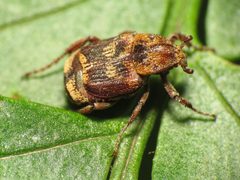
Valgus canaliculatus is a tiny scarab beetle in the Cetoniinae, measuring only 4–6 mm in length with a broad, strongly flattened body. The belongs to the tribe Valgini, one of only two tribes in Scarabaeidae possessing and -like setae. exhibit strong in feeding : only males visit flowers, using specially modified brush-like mouthparts to lap up nectar, while females do not feed on pollen. The species has been documented in association with galleries, where are laid and larvae feed on wood within the galleries, though whether this termophily is obligatory remains unclear.


Pronunciation
How to pronounce Valgus canaliculatus: //ˈvælɡəs ˌkæn.ə.lɪˈkjuː.lə.təs//
These audio files are automatically generated. While they are not always 100% accurate, they are a good starting point.
Identification
The combination of tiny size (4–6 mm), broad flattened body, and presence of -like setae covering and surfaces distinguishes this from most other scarab beetles. The tribe Valgini is one of only two in Scarabaeidae with such setae (the other being Hopliini). Males can be identified by their brush-like mouthparts. The species may be confused with other small flower-visiting beetles such as Acmaeodera species, but differs in its broader, more flattened body form and scale-like setae.
Images
Appearance
are tiny scarab beetles, measuring only 4–6 mm in length, with a broad, strongly flattened body broader than the similar-sized Acmaeodera neglecta. The body is covered with flattened, -like setae on both and surfaces as well as the legs. Males possess specially modified, brush-like mouthparts adapted for nectar feeding. The overall form is compact and somewhat -like in its flattened profile.
Habitat
Associated with galleries where are laid and larvae develop. are found on flowers. The has been collected in glade in Missouri, including dolomite glades and igneous glades with spring wildflowers such as lance-leaved coreopsis (Coreopsis lanceolata).
Distribution
Eastern and central North America. Documented from Alabama, Arkansas, Delaware, Florida, Georgia, Illinois, Indiana, Iowa, Kentucky, Louisiana, Maryland, Michigan, Missouri, New Jersey, North Carolina, Ohio, Oklahoma, Pennsylvania, South Carolina, Tennessee, Texas, Virginia, and West Virginia.
Seasonality
have been observed in spring (May) in Missouri, associated with blooming wildflowers on glades.
Diet
males feed on nectar using brush-like mouthparts; females do not feed on pollen. Larvae feed on wood within galleries.
Host Associations
- Coreopsis lanceolata - flower visitationlance-leaved coreopsis, a spring wildflower on glades where have been observed
- Termites - larval laid in galleries; larvae feed on wood within galleries
Life Cycle
are laid in galleries. Larvae feed on wood within the galleries. Whether the association with termites is obligatory or simply opportunistic exploitation of stable environment and food source remains unclear. emerge and males visit flowers to feed on nectar.
Behavior
males exhibit specialized flower-visiting , using modified brush-like mouthparts to lap up nectar. The demonstrates apparent termophily, with larvae developing in galleries. Adults have been observed on flowers in glade during spring.
Ecological Role
males may contribute to pollination through nectar feeding, though they do not consume pollen. Larvae function as wood-feeders within galleries, potentially contributing to decomposition processes in these microhabitats.
Human Relevance
No significant documented human relevance. The is of interest to entomologists studying scarab beetle , associations, and flower-visiting in beetles.
Similar Taxa
- Acmaeodera neglectaSimilar tiny size (4–6 mm) and flower-visiting , but A. neglecta is a jewel beetle (Buprestidae) with bronzy sheen, smaller punctures on , and lacks the broad flattened body form and -like setae of Valgus canaliculatus.
- Acmaeodera tubulusSimilar size and flower association, but distinguished by bronzy sheen, smaller punctures, and more rounded body form without -like setae.
- Other ValginiOther members of the tribe share the characteristic -like setae; identification to level requires examination of specific morphological features.
More Details
Termite association
The association of New World Valgini with is noteworthy. are laid in termite galleries and larvae feed on wood within these galleries, but it remains unclear whether this termophily is obligatory or if the beetles are simply taking advantage of the stable environment and accessible food source offered by termite colonies.
Sexual dimorphism in feeding
Unlike most flower-visiting beetles where both sexes may feed on pollen and nectar, in Valgus canaliculatus only males visit flowers and feed on nectar. The males do not feed on pollen, using their specialized mouthparts exclusively for nectar consumption.