
Acmaeodera tubulus
(Fabricius, 1801)
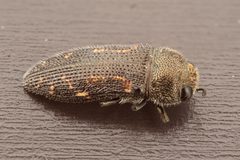
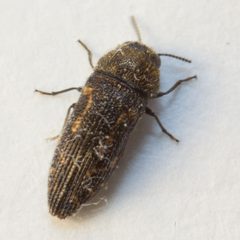
Acmaeodera tubulus is a small metallic wood-boring beetle in the Buprestidae, widespread across eastern North America. measure 5–7 mm and are recognized by their black coloration with bronzy sheen and paired rows of small yellow spots on the . This belongs to the informal 'tubulus-species group' within the , characterized by small size, similar maculation patterns, and membership in the 'Truncatae' group (straight prosternal margin). It is among the most abundant and widespread Acmaeodera species in the eastern United States.
Pronunciation
How to pronounce Acmaeodera tubulus: //ˌækmɪəˈdɛrə ˈtjuːbjuːləs//
These audio files are automatically generated. While they are not always 100% accurate, they are a good starting point.
Identification
Distinguished from similar eastern Acmaeodera neglecta by smaller, finer punctures on the pronotum, brighter surface sheen, and yellow spots on remaining separate rather than coalescing into irregular 'C'-shaped markings. A. neglecta is also duller and primarily restricted to glade in the south-central U.S. Distinguished from A. ornata by smaller size (A. ornata is 8–11 mm), lack of triangular depression on pronotum, bronzy rather than bluish elytral sheen, and fewer, larger yellow spots. Distinguished from southwestern in the tubulus-group (A. carlota, A. ornatoides, etc.) by geographic range and specific combinations of punctation , elytral interval texture, and setal characteristics.
Images
Appearance
Small , 5–7 mm in length. Body black with distinct bronzy sheen. bear eight small yellow spots arranged in two longitudinal rows of four spots each, though spot number may vary. Pronotum finely punctate. Elytral intervals subrugose and slightly irregular. Prosternal margin nearly straight, not retracted from sides (diagnostic for 'Truncatae' group). Elytra and do not separate during , giving a -like profile in flight similar to small halictid bees. Body covered with short, stiff setae.
Habitat
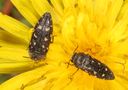
Occurs in diverse across eastern North America, including deciduous forests, forest edges, open woodlands, and areas with abundant flowering vegetation. frequently found on flowers in sunny conditions. Larval habitat consists of dead twigs and small branches of various hardwood trees.
Distribution
Eastern North America, widespread and common across the eastern United States. Records extend from Ontario, Canada southward throughout the eastern U.S. Not known from the southwestern U.S. or Mexico, where related in the tubulus-group occur.
Seasonality
Active in spring and early summer. observed on flowers from late spring through summer, with peak activity during flowering periods of plants.
Diet
feed on pollen and petals of a wide variety of flowers, including eastern beebalm (Monarda bradburiana), Krigia , and Rosa carolina. Larvae are wood borers in dead twigs and small branches of various hardwood trees.
Host Associations
- Monarda bradburiana - food sourcepollen and petal feeding
- Krigia sp. - food sourceobserved on flowers at higher elevations
- Rosa carolina - food sourcephotographed on flowers
- Crataegus viridis - larval reared from dead branches of green hawthorn
- Carya spp. - larval reared from several hickory
- Celtis occidentalis - larval reared from hackberry
- Gleditsia triacanthos - larval reared from honey locust
- Juglans nigra - larval reared from walnut
- Ostrya virginiana - larval reared from eastern hophornbeam
- Salix sp. - larval reared from willow
- Ulmus rubra - larval reared from slippery elm
Life Cycle
Complete . Larvae develop as wood borers in dead twigs and small branches of hardwood trees, taking one or more years to develop. emerge in spring and feed on flower pollen and petals. Specific timing of -laying and not documented.
Behavior
are active flower visitors, frequently observed feeding on pollen and petals. In , adults resemble small bees due to that do not separate during flight, creating a profile similar to halictid bees. Adults are often found in sunny conditions on flowers. When disturbed, adults may drop from flowers or fly short distances.
Ecological Role
function as through pollen feeding and transport. Larvae contribute to nutrient cycling by boring in dead hardwood branches. The serves as a food source for various . As a common and widespread species, it contributes to the guild of flower-visiting beetles in eastern North American .
Human Relevance
Occasionally encountered by entomologists and naturalists during field work. No significant economic importance; larvae do not attack living timber or structural wood. Sometimes photographed by macro photographers due to accessible flower-visiting . Used as a reference for understanding the tubulus-species group within Acmaeodera.
Similar Taxa
- Acmaeodera neglectaSimilar size and general appearance, but distinguished by larger pronotal punctures, duller surface, and yellow elytral spots often coalesced into irregular 'C'-shaped markings; primarily restricted to glade in south-central U.S.
- Acmaeodera ornataOverlaps in range and flower-visiting , but larger (8–11 mm), with bluish elytral sheen, triangular pronotal depression, and more numerous smaller creamy spots rather than larger yellow spots.
- Acmaeodera ornatoidesVery similar appearance but restricted to Oklahoma and Texas; not known from eastern U.S. where A. tubulus occurs.
More Details
Taxonomic group membership
A. tubulus is the namesake of the informal 'tubulus- group' within Acmaeodera, characterized by small size (<8 mm), black coloration with confused yellow maculations on , and membership in Horn's 'Truncatae' group (straight prosternal margin not retracted from sides). This group includes at least 11 species: A. tubulus, A. conoidea, A. neglecta, A. carlota, A. ligulata, A. neoneglecta, A. opuntiae, A. parkeri, A. sabinae, A. starrae, and A. thoracata. Most group members are restricted to the south-central and southwestern U.S., making A. tubulus the most widespread and easily identified member in the eastern U.S.
Flight morphology
Unlike most beetles, Acmaeodera have that do not separate during . In A. tubulus, this creates a distinctive -like flight profile that may serve as mimicry or simply reflect structural constraints of small body size.