
Acmaeodera ornata
(Fabricius, 1775)
Ornate Yellow-marked Buprestid
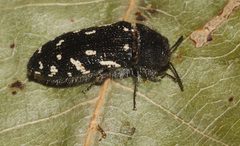
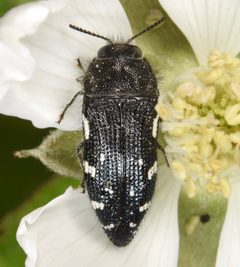
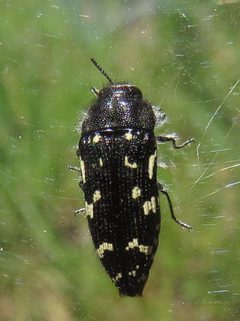
Acmaeodera ornata is a metallic wood-boring beetle in the Buprestidae, found across the eastern United States. measure 8–11 mm and are distinguished by their bluish with numerous small creamy spots. The is commonly encountered on flowers, particularly asteraceous species, where adults feed on pollen and nectar. Larval records remain poorly documented, with only unreliable historical reports of breeding in hickory and black locust.
Pronunciation
How to pronounce Acmaeodera ornata: /ækmiːoʊˈdɛrə ɔrˈneɪtə/
These audio files are automatically generated. While they are not always 100% accurate, they are a good starting point.
Identification
Distinguished from the more common Acmaeodera tubulus by larger size (8–11 mm vs. 5–7 mm), bluish rather than bronzy elytral sheen, and smaller, more numerous creamy spots rather than larger yellow spots. The pronotal depression is also distinctive. The similar Acmaeodera ornatoides occurs in Oklahoma and Texas, not in the eastern U.S. range of A. ornata. Acmaeodera neglecta is smaller with duller surface and coalesced spot patterns.
Images
Habitat
Occurs in open including glades, prairies, and woodland edges where flowers are abundant. Associated with areas supporting diverse spring-blooming wildflowers, particularly yellow composites.
Distribution
Eastern North America, ranging across the eastern United States. More widespread than A. neglecta but less commonly encountered than A. tubulus. Not known from the southwestern U.S., where related is highest.
Seasonality
active in spring, with observations from late spring through early summer. Peak activity coincides with bloom periods of coreopsis and other asteraceous flowers.
Diet
feed on pollen and nectar of flowers, especially asteraceous including Coreopsis and Leucanthemum. Larval feeding habits unknown except for unverified historical reports of wood-boring in hickory and black locust.
Host Associations
- Coreopsis - feedingpollen and nectar source
- Leucanthemum vulgare - feedingpollen and nectar source
- Carya - possible larval unreliable historical report
- Robinia pseudoacacia - possible larval unreliable historical report
Life Cycle
Complete with wood-boring larval stage typical of Buprestidae. Specific larval and development details unknown. emerge in spring.
Behavior
visit flowers to feed on pollen and nectar. In , the create a -like profile resembling small halictid bees. The long body hairs function in pollen collection. Adults have been observed on a variety of flower during spring bloom periods.
Ecological Role
contribute to pollination of spring-blooming wildflowers through pollen transport on body hairs. Larval role in wood decomposition unknown due to lack of confirmed records.
Human Relevance
Of interest to entomologists and collectors due to distinctive appearance. No known economic importance. Occasionally photographed by naturalists during spring wildflower season.
Similar Taxa
- Acmaeodera tubulusSmaller (5–7 mm), bronzy rather than bluish sheen, larger yellow spots in two longitudinal rows, lacks pronotal depression
- Acmaeodera neglectaSmaller (4–6 mm), duller surface, spots often coalesced into C-shaped markings, restricted primarily to glade
- Acmaeodera ornatoidesVery similar appearance but restricted to Oklahoma and Texas, not overlapping with A. ornata in eastern U.S.
More Details
Taxonomic history
Described by Fabricius in 1775. One of only five Acmaeodera occurring in the eastern U.S., where diversity drops considerably compared to the southwestern U.S. and Mexico.
Research gaps
Larval remain unknown despite extensive rearing attempts. Reliable host confirmation would require successful rearing from known woody material.