
Acmaeodera neglecta
Fall, 1899
Acmaeodera neglecta is a small metallic wood-boring beetle in the Buprestidae, measuring 4–6 mm in length. It occurs primarily in the south-central United States, with records from Oklahoma, Texas, Arkansas, and Missouri. are flower visitors, particularly on yellow composites such as Coreopsis and Thelesperma. The was described by Fall in 1899 and remained unreported from Missouri until 1987 due to its close resemblance to the more common A. tubulus.

Pronunciation
How to pronounce Acmaeodera neglecta: //ˌækmiːoʊˈdɪərə nɪˈɡlɛktə//
These audio files are automatically generated. While they are not always 100% accurate, they are a good starting point.
Identification
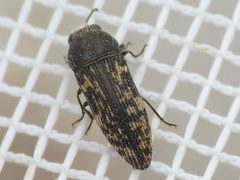
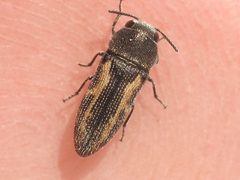
Distinguished from the similar and more widespread Acmaeodera tubulus by: (1) slightly larger elytral punctures, (2) duller surface sheen, and (3) yellow spots on usually longitudinally coalesced into irregular C-shaped markings rather than remaining as discrete spots. Smaller than A. ornata (8–11 mm), which has bluish elytral cast and creamy rather than yellow spots.
Images
Appearance
Small jewel beetle, 4–6 mm in length, with black coloration and bronzy sheen. bear yellow spots that often coalesce longitudinally into irregular C-shaped markings on each side. Surface duller than A. tubulus, with slightly larger punctures. Elytra , not separating in .
Habitat
Primarily associated with glade —open, rocky areas with thin soils and abundant spring wildflowers. Also found in native prairie with diverse blooming flora.
Distribution
South-central United States: Oklahoma, Texas, Arkansas, and Missouri. Most frequently encountered in the Ozark and Ouachita regions.
Seasonality
active in spring, with peak activity during May–June when wildflowers are in bloom. Observations from early June in Oklahoma and spring collections in Missouri.
Diet
feed on pollen and nectar of flowers, particularly yellow composites (Asteraceae) including Coreopsis grandiflora, Thelesperma filifolium, and Gaillardia pulchella. Larval diet unknown but presumed to be wood-boring in hardwood branches based on -level .
Host Associations
- Coreopsis grandiflora - flower visitation feeding
- Thelesperma filifolium - flower visitation feeding
- Gaillardia pulchella - flower visitation feeding
Life Cycle
Complete with wood-boring larval stage typical of . Specific larval plants unknown for this . emerge in spring to feed on flowers and mate.
Behavior
are flower visitors. In , the create a profile resembling small halictid bees (sweat bees), which may serve as mimicry. Adults have been observed sharing flowers with including A. mixta and A. ornatoides.
Ecological Role
function as while feeding on flowers. Larvae contribute to wood decomposition as borers in dead or dying hardwood branches.
Human Relevance
No significant economic or medical importance. Of interest to coleopterists and naturalists due to identification challenges and restricted distribution.
Similar Taxa
- Acmaeodera tubulusNearly identical in size and coloration; distinguished by smaller, discrete yellow spots (not coalesced), finer elytral punctures, and shinier surface
- Acmaeodera ornataLarger (8–11 mm), broader and more flattened body, bluish elytral cast, creamy spots, and triangular pronotal depression
- Acmaeodera ornatoidesOccurs in same region (Oklahoma, Texas); similar in appearance but with different spot pattern and distribution
More Details
Taxonomic History
Remained unreported from Missouri until Nelson (1987) recognized specimens collected by T.C. MacRae, due to close resemblance to A. tubulus
Flight Mimicry
that do not separate during create -like silhouette, possibly mimicking small Halictidae (sweat bees)