
Sphaeridiinae
Latreille, 1802
Tribe Guides
3Sphaeridiinae is a of water scavenger beetles within the Hydrophilidae, comprising terrestrial and semi-terrestrial associated with decaying organic matter. The subfamily includes approximately 13 in North America alone, with numerous genera distributed globally across diverse from to forest litter. Members exhibit diverse ecological specializations including , myrmecophily, and associations with decaying plant material. The group has undergone extensive taxonomic revision due to cryptic and convergent morphological adaptations.
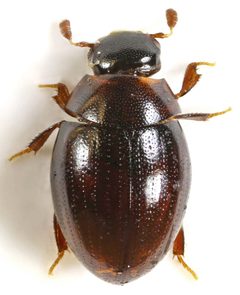
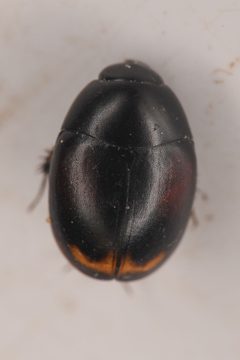
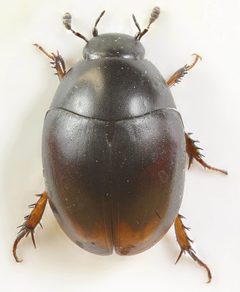
Identification
Sphaeridiinae can be distinguished from other Hydrophilidae by the combination of: antennal club with three palps (vs. four in Hydrophilinae); mesoventrite with a distinct elevation or keel; and often compact body form adapted for life in confined spaces such as or decaying matter. Within the subfamily, tribes are distinguished by characters including antennal club structure, body shape, and male genitalia; for example, Megasternini possess a subdistal median spur on the hind wing and sucking discs on male .
Images
Habitat
Diverse decaying organic substrates including mammalian ( ), leaf litter, decaying wood, fungal , garden compost, decaying seaweed, carrion, and rotting plant material including banana trees. Some species inhabit specialized microhabitats: cloud and montane forest litter (Motonerus), nests and (myrmecophilous including Chimaerocyon), fungal hyphae on fallen wood (some Dactylosternum), and subterranean cave systems with water (Cercyon inquinatus).
Distribution
distribution with major faunas documented in North America (62+ ), Australia (numerous ), China and Japan (diverse Dactylosternum and Coelostoma faunas), Neotropics, Greater Antilles, Polish Carpathians, and Sulawesi. Specific records include: Florida Keys and Mexico (Pelosoma pecki); Turkey (first record of Cercyon inquinatus); Polish Carpathians (17 species across 263–1957 m elevation); and Malaysian Pahang and Sumatra (Chimaerocyon).
Diet
feed on mammalian excrement, particularly sheep and cattle . Other species consume decaying organic matter including rotting plant material, fungal , and carrion. Specific dietary associations are documented for -trapped species (sheep/cattle dung mixture) and for species associated with nests or colonies where feeding habits may involve -derived resources.
Life Cycle
stages described for some including Dactylosternum cacti; larvae of this species have been compared morphologically to associated larvae of D. subrotundum from Brazil. Larvae of Cercyon insularis and C. taino have been associated with using COI barcode sequences and illustrated.
Behavior
Some exhibit flightlessness (Motonetus apterus and M. oosternoides), an unusual condition within the group. Myrmecophilous species including Chimaerocyon shimadai inhabit . potential suggested by capture of Pachysternum capense (native to Southern Europe) in the Polish Tatra Mountains, indicating possible unrecognized routes for small insects from Southern to Northern Europe.
Ecological Role
Decomposers of mammalian and decaying organic matter, contributing to nutrient cycling in terrestrial . Some facilitate breakdown of cellulose-rich materials through associations with decaying wood and fungal .
Similar Taxa
- HydrophilinaeAquatic water scavenger beetles with four palps on antennal club and different mesoventral structure; Sphaeridiinae are primarily terrestrial or semi-terrestrial with three antennal palps
- CoelostomatinaeOverlapping preferences in decaying organic matter but distinguished by antennal structure and male genitalia characters
Sources and further reading
- BugGuide
- iNaturalist taxon
- NCBI Taxonomy
- Catalogue of Life
- Omicrini from Sulawesi Utara, Indonesia (Coleoptera : Hydrophilidae : Sphaeridiinae)*
- A revision of the Neotropical genus Motonerus Hansen (Coleoptera: Hydrophilidae: Sphaeridiinae)
- Coprophagous Hydrophilid Beetles (Coleoptera, Hydrophilidae, Sphaeridiinae) Distribution in the Polish Carpathians
- Description of the preimaginal stages of Dactylosternum cacti (Coleoptera: Hydrophilidae, Sphaeridiinae)
- Review of Dactylosternum Wollaston, 1854 from China and Japan (Coleoptera, Hydrophilidae, Sphaeridiinae)
- Chimaerocyon gen. nov., a morphologically aberrant myrmecophilous genus of water scavenger beetle (Coleoptera: Hydrophilidae: Sphaeridiinae)
- Australian Sphaeridiinae (Coleoptera : Hydrophilidae): A taxonomic outline with descriptions of new genera and species
- REVISION OF THE SUBFAMILY SPHAERIDIINAE OF AMERICA NORTH OF MEXICO (COLEOPTERA: HYDROPHILIDAE). SUPPLEMENTUM 1
- Coelostoma orbiculare (Fabricius) (Coleoptera: Hydrophilidae: Sphaeridiinae): New Records and Distribution in North America
- Review of the Chinese species of the genus Coelostoma Brullé, 1835 <br />(Coleoptera: Hydrophilidae: Sphaeridiinae)
- REVISION OF THE SUBFAMILY SPHAERIDIINAE OF AMERICA NORTH OF MEXICO (COLEOPTERA: HYDROPHILIDAE). SUPPLEMENTUM 2
- REVISION OF THE SUBFAMILY SPHAERIDIINAE OF AMERICA NORTH OF MEXICO (COLEOPTERA: HYDROPHILIDAE)
- A review of the Cercyon Leach (Coleoptera, Hydrophilidae, Sphaeridiinae) of the Greater Antilles
- First record of Cercyon (s. str.) inquinatus Wollaston, 1854 from Turkey with notes about this problematic species (Coleoptera: Hydrophilidae: Sphaeridiinae: Megasternini)
- Additional fauna of Coelostoma Brullé, 1835 from China, with re-establishment of Coelostoma sulcatum Pu, 1963 as a valid species (Coleoptera, Hydrophilidae, Sphaeridiinae)