
Helophoridae
Leach, 1815
water scavenger beetles, crawling water beetles
Genus Guides
1Helophoridae is a of small aquatic beetles within the superfamily Hydrophiloidea, containing the single Helophorus. The family comprises approximately 191 distributed primarily across the Holarctic region, with 150 species in the Palearctic and 41 in North America. A limited number of species occur in the Afrotropical region (six species), Central America, and the Indomalayan region (one species in northern India). Species inhabit diverse freshwater including springs, ponds, temporary pools, and running waters, with many showing strong associations with specific hydrological regimes.
Pronunciation
How to pronounce Helophoridae: //hɛˌlɒfəˈraɪdi//
These audio files are automatically generated. While they are not always 100% accurate, they are a good starting point.
Identification
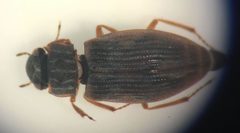
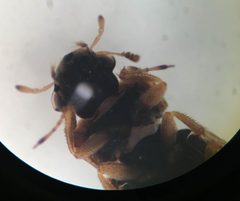
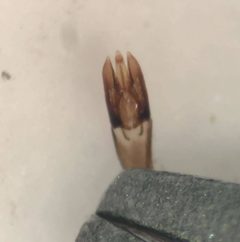
Distinguished from other Hydrophiloidea by the combination of: single Helophorus; deeply with distinct longitudinal grooves; short, clubbed ; elongated maxillary palps; and crawling-adapted legs without swimming fringes. Separated from Hydrophilidae by the striate elytra and more compact body form; from Hydrochidae by the presence of elytral and different antennal structure; from Hydraenidae by larger size and distinct elytral . identification requires examination of genitalia and detailed elytral and pronotal sculpture patterns.
Images
Appearance
Small beetles, typically 2–6 mm in length. Body form compact and somewhat convex, with a distinctive series of deep longitudinal grooves or on the . short with a distinct club of three segments. Maxillary palps elongated, often conspicuous. Legs adapted for crawling rather than swimming, with bearing well-developed claws. Coloration generally dark, ranging from black to brown, often with reddish or yellowish markings on the elytra or pronotum in some .
Habitat
Freshwater including springs, spring-fed pools, ponds, temporary pools, slow-flowing streams, and river margins. Some are characteristic of cold, mountainous running waters; others occur in lowland temporary pools that dry seasonally. Specific associations include well-heated spring puddles, acidophilic stagnant waters, and winter or summer rainfall regimes in southern Africa. Habitat specificity varies by species, with some showing narrow ecological requirements.
Distribution
Primarily Holarctic: Palearctic region (150 , concentrated in Europe and Asia), Nearctic region (41 species in North America). Disjunct in Afrotropical region (Ethiopian Highlands, South Africa, Namibia, Kenya), Central America, and northern India (Indomalayan region). In Europe, documented from Italy (Brescia province: 10 species), Czech Republic, Ukraine, Turkey, and Portugal.
Seasonality
activity generally concentrated in spring and early summer. Some associated with temporary water bodies disappear after drying in summer. In southern Africa, seasonal activity patterns differ between winter rainfall and summer rainfall species, suggesting . Specific records indicate adults present in June and August for some Siberian species.
Life Cycle
includes , larval, pupal, and stages. Larvae are aquatic and predatory. Specific developmental details vary by ; some species in seasonal rainfall areas show life cycle shifts tied to hydrological regimes. No detailed information on egg or pupal stages available for the as a whole.
Behavior
Primarily crawling rather than swimming; legs adapted for substrate locomotion. densities can be highly variable: up to 100 individuals per square meter recorded in favorable years for some , with local absence in unfavorable years or after drying. of some species are strong dispersers, colonizing temporary habitats.
Ecological Role
Aquatic as larvae; may function as scavengers or predators. Component of diverse aquatic in springs, ponds, and running waters. Some serve as indicators of specific conditions, including water temperature, permanence, and acidity.
Human Relevance
Some of conservation concern due to restricted distributions and specificity. Helophorus villosus proposed for inclusion in the Red Book of Ukraine. Helophorus auriculatus listed as endangered in Japan. Used as bioindicators in freshwater habitat assessment. No known agricultural or medical significance.
Similar Taxa
- HydrophilidaeSimilar aquatic and general body form; distinguished by lack of , presence of swimming-adapted middle and hind legs with fringes of setae, and typically larger size.
- HydrochidaeSimilar small size and aquatic ; distinguished by different antennal structure, lack of deep elytral , and more elongate body form.
- HydraenidaeSimilar association with aquatic ; distinguished by much smaller size (usually <2 mm), different body shape, and reduced elytral .
More Details
Taxonomic history
Traditionally treated as Helophorinae within Hydrophilidae; now recognized as distinct Helophoridae within Hydrophiloidea based on morphological and molecular evidence. Monogeneric family containing only Helophorus.
Biogeographic patterns
Afrotropical represent at least two independent events from Palearctic ancestors. South African species show evidence of associated with development of winter rainfall regime during Plio-Pleistocene.
Sources and further reading
- BugGuide
- GBIF taxonomy match
- iNaturalist taxon
- NCBI Taxonomy
- Catalogue of Life
- First record of Helophorus villosus Düftschmid, 1805 (Coleoptera: Hydrophyloidea: Helophoridae) in Ukraine
- Out of the Palaearctic: the Helophorus water beetles of the Afrotropical Region (Coleoptera: Helophoridae)
- Erzurum Jeolojik Oluşumları ve Muş Hamurpet Gölü Helophoridae, Hydrochidae, Hydrophilidae (Coleoptera) Üzerine Faunistik Bir Çalışma A Faunistic Study of Helophoridae, Hydrochidae, Hydrophilidae (Coleoptera) in Erzurum Geological Formations and Muş Hamurpet Lake
- An annotated checklist of the aquatic Polyphaga (Coleoptera) of Egypt III. Families: Helophoridae, Georissidae, Hydrochidae, Spercheidae, Scirtidae, Elmidae, Dryopidae, Limnichidae and Heteroceridae
- Aquatic Coleoptera (Dryopidae, Dytiscidae, Elmidae, Gyrinidae, Haliplidae, Helophoridae, Hydrochidae, Hydrophilidae, Noteridae, Psephenidae) of Iowa: Distributional Records and Notes
- Ecological Factors Affecting Distribution of the Aquatic Beetles (Coleoptera: Hydrophilidae, Helophoridae) of Beyşehir Lake and Adjacent Areas in Turkey
- Water beetles (Coleoptera: Haliplidae, Dytiscidae, Helophoridae, Hydrophilidae, Hydraenidae, Elmidae, Psephenidae, Scirtidae) of the Slavíč river basin, Czech Republic
- New data on the little-known species of the water scavenger beetle Helophorus pitcheri Angus, 1970 (Coleoptera: Hydrophiloidea: Helophoridae)
- Life history of the endangered Japanese aquatic beetle Helophorus auriculatus (Coleoptera: Helophoridae) and implications for its conservation
- New Faunistic Records of Helophoridae, Hydrochidae, and Hydrophilidae (Coleoptera) from the Wetland Habitats of Tekirdağ Province, Türkiye
- Contributo alla conoscenza dei coleotteri acquatici nei bacini idrografici della provincia di Brescia (Lombardia) (Coleoptera: Gyrinidae, Haliplidae, Noteridae, Dytiscidae, Helophoridae, Hydrochidae, Hydrophilidae, Hydraenidae, Psephenidae, Heteroceridae, Dryopidae, Elmidae)
- The first record of Helophorus minutus Fabricius, 1775 (Coleoptera: Helophoridae) for Portugal with some notes about H. calpensis Angus, 1988