
Coelostoma
Brullé, 1835
Species Guides
1Coelostoma is a diverse of water scavenger beetles in the Hydrophilidae, first described by Brullé in 1835. The genus comprises approximately 111 described and is considered one of the most species-rich genera within Hydrophilidae. Members are found across the Old World, primarily in the Oriental, Afrotropical, and Palearctic regions, with limited representation in the Australian region. The genus is absent from the Nearctic and Neotropical regions, where related genera occupy similar .
Pronunciation
How to pronounce Coelostoma: /ˌsiːloʊˈstoʊmə/
These audio files are automatically generated. While they are not always 100% accurate, they are a good starting point.
Identification
Distinguished from other Hydrophilidae by the combination of deeply excised , arrow- shaped mesoventral elevation, and the characteristic metaventral structure with anteriorly projecting raised portion. The absence of serial punctures on further separates Coelostoma from many related genera. -level identification requires examination of male genitalia and detailed morphometric analysis.
Images
Appearance
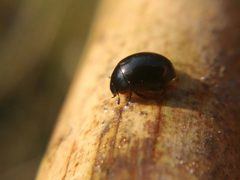
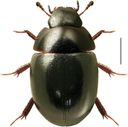
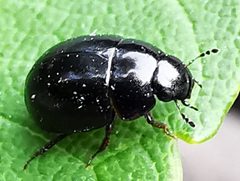
Body rather convex, brown to black in coloration. medium in size, deeply excised internally. with 9 antennomeres and loosely segmented antennal club. Mesoventrite with arrow- shaped elevation. Metaventrite longer than mesoventral elevation, with strongly raised median portion broadly projecting anteriorly and abutting mesoventral process. lacking serial punctures.
Habitat
Aquatic and semi-aquatic environments including edges of ponds and streams with grass cover, muddy lands beside paddy fields, forest streams, and wet stone surfaces with running water. occur under stones at stream margins, beneath grass roots on wet stones, in accumulations of rotten leaves, and in shallow vegetated standing water. Some inhabit artificial water bodies such as and agricultural fields.
Distribution
Primarily Old World distribution encompassing Oriental, Afrotropical, and Palearctic regions. Limited presence in Australian region. Absent from Nearctic and Neotropical regions. Documented from China (Yunnan, Fujian, Guangdong, Xizang, Hunan, Guizhou, Chongqing, Shanxi, Zhejiang, Jiangxi, Guangxi, Hong Kong), Taiwan, India (Deccan Peninsula), Indonesia, Malaysia, Nepal, Vietnam, Himalayas, Myanmar, and Korea. North American records exist for at least one (C. orbiculare).
Diet
Decomposing organic material, , and rotting aquatic plants. Specific feeding habits documented through association with these materials in descriptions.
Behavior
are predominantly and exhibit , sometimes attracted to light sources. Activity patterns include both submerged and shore-zone border . Some demonstrate syntopic co-occurrence with .
Ecological Role
Water scavenger beetles inhabiting aquatic and semi-aquatic environments, contributing to decomposition processes through consumption of organic detritus and .
Similar Taxa
- Other Hydrophilidae generaCoelostoma differs in the unique combination of deeply excised , arrow- shaped mesoventral elevation, and anteriorly projecting metaventral process; related in Nearctic and Neotropical regions occupy similar but are taxonomically distinct
More Details
Taxonomic diversity
One of the most diverse in Hydrophilidae with ongoing description, particularly from under-sampled regions such as China where recent studies have significantly expanded known diversity
Subgeneric classification
Some placed in subgenus Lachnocoelostoma, as seen in C. taiwanense and C. horni
Sources and further reading
- BugGuide
- Wikipedia
- GBIF taxonomy match
- iNaturalist taxon
- NCBI Taxonomy
- Catalogue of Life
- Additional fauna of Coelostoma Brullé, 1835 from China, with re-establishment of Coelostoma sulcatum Pu, 1963 as a valid species (Coleoptera, Hydrophilidae, Sphaeridiinae)
- Review of the genus Coelostoma of Taiwan with description of a new species (Coleoptera: Hydrophilidae)
- Coelostoma orbiculare (Fabricius) (Coleoptera: Hydrophilidae: Sphaeridiinae): New Records and Distribution in North America
- Review of the Chinese species of the genus Coelostoma Brullé, 1835 <br />(Coleoptera: Hydrophilidae: Sphaeridiinae)
- Occurrence of <i>Coelostoma</i> (<i>Lachnocoelostoma</i>) <i>horni</i> (Régimbart, 1902) (Coleoptera: Hydrophilidae) from Deccan Peninsular, India