
Agriotes
Eschscholtz, 1829
click beetles, wireworms (larvae)
Species Guides
21- Agriotes apicalis(Apical Click Beetle)
- Agriotes arcanus(Arcane Click Beetle)
- Agriotes collaris(Collared Click Beetle)
- Agriotes criddlei(Criddle's Click Beetle)
- Agriotes ferrugineipennis(Rusty Click Beetle)
- Agriotes fucosus(Dark Click Beetle)
- Agriotes insanus
- Agriotes isabellinus(Isabelline Click Beetle)
- Agriotes limosus(Muddy Click Beetle)
Agriotes is a large of click beetles ( Elateridae) containing approximately 274 described distributed across the Americas, Asia, and Europe. The genus includes numerous agricultural pest species whose larvae, known as wireworms, feed on crop roots and tubers. Several Palearctic species have become in North America, where they threaten potato and cereal production. are attracted to species-specific , enabling monitoring and mass trapping programs.
Pronunciation
How to pronounce Agriotes: /ˈæɡriˌoʊtiːz/
These audio files are automatically generated. While they are not always 100% accurate, they are a good starting point.
Identification
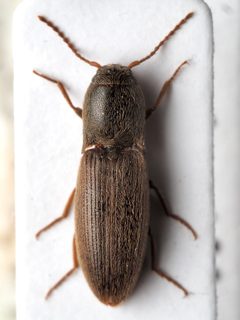
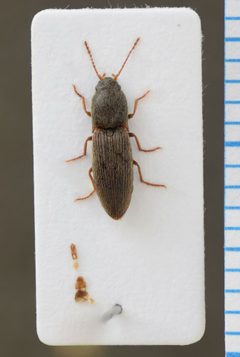
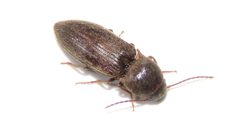
Agriotes beetles are small to medium-sized elaterids with the characteristic click beetle body form: elongated, somewhat parallel-sided, with a pronotum that tapers posteriorly and often bears distinct angles. Larvae (wireworms) are slender, cylindrical, hard-bodied, and yellowish to brownish with a shiny . -level identification requires examination of male genitalia and other subtle morphological characters; trap captures can assist in distinguishing sympatric species.
Images
Habitat
inhabit grasslands, meadows, and agricultural fields. Larvae develop in soil, where they occupy the root zone of plants. Permanent grasslands serve as from which adults disperse into adjacent cropland. The has been detected in green yard waste, which can facilitate human-mediated .
Distribution
Native range spans the Palearctic (Europe, Asia) and Nearctic (North America) regions. Multiple Palearctic —including A. lineatus, A. obscurus, and A. sputator—have established in North America. Individual species show varying distributions: A. rufipalpis is abundant in the Carpathian lowlands, while A. obscurus has shown range shifts in Hungary.
Seasonality
patterns vary by and latitude. In Central Italy, A. litigiosus, A. brevis, and A. sordidus show distinct seasonal emergence patterns. In temperate regions, adults are typically active from late spring through summer, with peak activity varying among sympatric species.
Diet
Larvae (wireworms) feed on roots, tubers, and seeds of plants. Specific associations include potatoes (attacked by A. lineatus), wheat, and other cereal crops. The degree of polyphagy versus host specificity varies among but is not fully resolved for most.
Life Cycle
Complete with , larval, pupal, and stages. Larvae are the damaging stage, living in soil for multiple years (2-5 years depending on and conditions) before pupating. Adults are short-lived and do not feed significantly. Specific developmental durations vary by species and environmental conditions.
Behavior
males locate females using ; A. mancus males respond to geranyl butanoate and geranyl hexanoate, while other have distinct blends. Males show differential trap entry : A. lineatus males frequently enter A. obscurus traps, but the reverse is rare. Larvae exhibit behavioral responses to soil-borne volatile organic compounds and fungi, which may be exploited for management.
Ecological Role
Larvae function as root-feeding herbivores in soil . As pests, they can significantly reduce crop yields. In grassland , they contribute to nutrient cycling through root herbivory. Their role in natural ecosystems versus agricultural systems differs substantially.
Human Relevance
Major agricultural pests of potatoes, cereals, and other crops. Larval feeding causes direct economic damage and can render crops unmarketable. -based monitoring and mass trapping are used for management. are subject to and border inspection; environmental methods have been developed to detect hidden life stages in yard waste and other materials. A. lineatus was detected as an unexpected in Washington State yard waste.
Similar Taxa
- Other Elateridae generaMany elaterid larvae are called wireworms and cause similar damage; identification to requires examination or molecular methods.
More Details
Pheromone research
have been identified for multiple : A. mancus (geranyl butanoate + geranyl hexanoate), A. lineatus, A. obscurus, and A. sputator. These enable species-specific monitoring, though some cross-attraction occurs.
Invasive species detection
Environmental (eDNA) sampling has successfully detected A. lineatus in green yard waste, demonstrating potential for non- detection of cryptic life stages in border inspection contexts.
Sources and further reading
- BugGuide
- Wikipedia
- GBIF taxonomy match
- iNaturalist taxon
- NCBI Taxonomy
- Catalogue of Life
- Agriotes lineatus Archives - Entomology Today
- Beetle in a Haystack: Environmental DNA Reveals Invasive Pest Incursions
- Distribution of economically important click beetles and the first record of Agriotes sordidus Illiger in Hungary
- Mass trapping wild Agriotes obscurus and Agriotes lineatus males with pheromone traps in a permanent grassland population reservoir
- Behavioural responses of Agriotes lineatus and Agriotes litigiosus wireworms to natural substances, synthetic volatile organic compounds and entomopathogenic fungi: Implications for sustainable pest management
- Sex pheromone of Nearctic Agriotes mancus and its similarity to that of three Palearctic Agriotes invasive in North America
- Species Composition and Emergence Patterns of Agriotes litigiosus, A. brevis and A. sordidus (Coleoptera: Elateridae) in Central Italy.