
Agriotes obscurus
(Linnaeus, 1758)
dusky wireworm, obscure click beetle
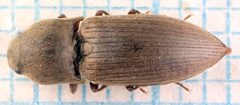
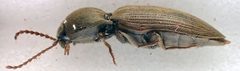
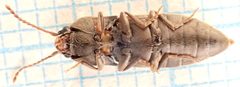
Agriotes obscurus is a click beetle native to Europe and northern Asia that has become an established pest in western North America since its accidental introduction around 1900. The larvae, known as wireworms, are significant agricultural pests that feed on tubers, seeds, and roots of numerous crops including potatoes, cereals, and vegetables. are dark brown to black beetles 7–10 mm long, distinguishable from related by their pronotum and elytral ridges. The species has a prolonged of 2–4 years depending on temperature, with larvae passing through 8–13 instars before .
Pronunciation
How to pronounce Agriotes obscurus: //əˈɡraɪ.əˌtiːz əbˈskjʊərəs//
These audio files are automatically generated. While they are not always 100% accurate, they are a good starting point.
Identification
Distinguished from A. sputator and A. lineatus by pronotum wider than long with strongly curved sides (A. sputator has pronotum slightly longer than wide, wider near with less curved sides; A. lineatus has striped ). Molecular identification possible. Larvae difficult to separate from A. lineatus; abdominal longer than wide and narrowing posteriorly in A. obscurus versus different shape in A. lineatus.
Images
Habitat
Native occur in non-farmed areas and grasslands, particularly at higher altitudes with lower temperatures, higher precipitation, and acidic, humus-rich soils. In western Canada, distribution is clustered and temporally stable in non-farmed within agricultural landscapes. feed on grass leaves in these natural habitats before moving to crops.
Distribution
Native to central and northern Europe (France, Alps region, UK, Germany, Poland, Scandinavia, Baltic states, extending to Spain, Italy, Norway, Finland, Ukraine, western Russia, Serbia, Montenegro, Bulgaria, Romania) and northern Asia (Armenia, Azerbaijan, northern Kazakhstan, parts of Siberia, northern Mongolia, northern China, Korea). Introduced to western Canada around 1900; now established in British Columbia (widespread on Vancouver Island and Fraser Valley) and Washington State, USA, with potential spread to other parts of North America.
Seasonality
emerge in late spring and early summer. laying starts in spring. completed in 4 years in cooler regions, 2–3 years in warmer conditions.
Diet
Larvae are , feeding on roots, seeds, and tubers of numerous plants. Documented include potatoes, beets, cereals, sunflower, vegetables, ornamentals, and grasses including Lolium perenne and Holcus lanatus. In grasslands, larvae also feed on common yarrow (Achillea millefolium). feed on leaves of grasses.
Host Associations
- Solanum tuberosum - larval food plantserious damage to tubers
- Triticum aestivum - larval food plantseedling mortality
- Zea mays - larval food plantserious damage reported
- Beta vulgaris - larval food plantroot crop damage
- Helianthus annuus - larval food plantoil crop damage
- Lolium perenne - larval food plantpreferred grass in grasslands
- Holcus lanatus - larval food plantpreferred grass in grasslands
- Achillea millefolium - larval food plantfrequently fed upon in Austrian grasslands
- various grasses - food plant feed on grass leaves
Life Cycle
laid in soil in spring; hatch after approximately 3 weeks. Larvae pass through 8–13 instars over 2–4 years depending on temperature (4 years in central Europe, as short as 2 years in warmer regions). At 20°C, first instar lasts ~2.5 weeks, 6th and higher instars last 100+ days each. Pupal stage lasts 2 weeks. survive several months and overwinter.
Behavior
Larvae are attracted to autoclaved millet and cereal seeds, facilitating trapping. Males respond strongly to -specific (geranyl hexanoate and geranyl octanoate in 1:4 ratio produced by females). Males show limited movement range; in mass trapping studies, 35–58% of captured males moved in from outside trap arrays. A. lineatus males more frequently enter A. obscurus pheromone traps than vice versa. Larvae exhibit reduced acceptance of food sources with high concentrations of Metarhizium brunneum conidia.
Ecological Role
Larvae function as root-feeding herbivores in grassland . In agricultural systems, they are significant pests causing economic damage through direct feeding. serve as prey for . Susceptible to fungi including Metarhizium brunneum and such as Paracodrus apterogynus (rarely observed in natural ).
Human Relevance
Major agricultural pest in Europe and pest in North America. Larvae cause serious damage to potato tubers (up to one third of tubers affected, up to 10 feeding holes per tuber), cereal seedlings (mortality), and numerous other crops. Management relies on including monitoring, crop , tillage timing, and with Metarhizium brunneum. Historical control with now-banned organochlorides; current reliance on neonicotinoids with drawbacks including to and limited reduction.
Similar Taxa
- Agriotes sputatorPronotum slightly longer than wide versus wider than long in A. obscurus; pronotum wider near with less curved, almost parallel sides
- Agriotes lineatus distinctly striped versus unstriped or uniformly colored in A. obscurus; larvae have different abdominal shape (not longer than wide and narrowing posteriorly)
More Details
Pheromone chemistry
Female-produced contains geranyl hexanoate and geranyl octanoate in 1:4 ratio; synthetic lures use 1:1 ratio. Pheromone is stable for several months but has short attraction range of only a few meters.
Invasion history
Introduced to western Canada around 1900, possibly with soil of hop plants. First recorded in Washington State in 1997; surveys 2004–2005 confirmed wide distribution in western Washington with indications in Oregon.
Molecular identification
-based methods can distinguish and larvae from morphologically similar .
Sources and further reading
- BugGuide
- Wikipedia
- GBIF taxonomy match
- iNaturalist taxon
- NCBI Taxonomy
- Aphytis Project Final Report | Entomology Research Museum
- Beetle in a Haystack: Environmental DNA Reveals Invasive Pest Incursions
- Bug Eric: Year-end Wrap-up
- The “obscure” Dicerca | Beetles In The Bush
- OBSERVATIONS ON THE BIOLOGY OF AGRIOTES OBSCURUS L.
- Mass trapping wild Agriotes obscurus and Agriotes lineatus males with pheromone traps in a permanent grassland population reservoir
- On the Ecology of Beetles of the Genus Agriotes with Special Reference to A. Obscurus
- Interaction of the wireworm species Agriotes obscurus , A. sputator and A. lineatus with a new granule formulation of Metarhizium brunneum
- Automated video-tracking analysis of Agriotes obscurus wireworm behaviour before, during and after contact with thiamethoxam- and imidacloprid-treated wheat seeds
- Mark–recapture of Agriotes obscurus and Agriotes lineatus with dense arrays of pheromone traps in an undisturbed grassland population reservoir
- Horizontal transmission of Metarhizium brunneum conidia from sporulating cadavers to Agriotes obscurus adults
- Distribution of olfactory and some other antennal sensilla in the male click beetle Agriotes obscurus L. (Coleoptera : Elateridae)