
Agriotes sputator
(Linnaeus, 1758)
Spitting Click Beetle, Common Click Beetle
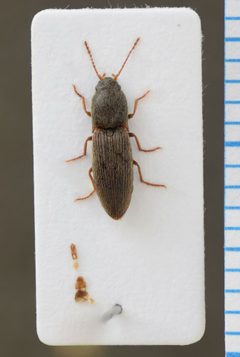
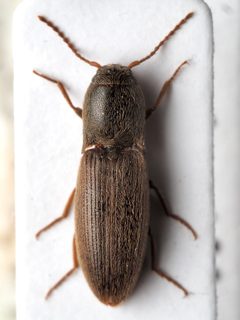
Agriotes sputator is a click beetle native to Europe, with established in parts of western Asia, North Africa, and an introduced range in eastern Canada. are small (6–9 mm), dark brown to black with reddish-brown and legs. The larvae, known as wireworms, are soil-dwelling agricultural pests that feed on roots and germinating seeds. The completes its in up to five years, with larvae developing through multiple growth stages before . It is considered a serious pest of cereals, potatoes, and other crops, and is monitored using traps baited with geranyl butanoate.
Pronunciation
How to pronounce Agriotes sputator: /əˈɡraɪ.oʊtɛs ˈspju.teɪ.tɔr/
These audio files are automatically generated. While they are not always 100% accurate, they are a good starting point.
Identification
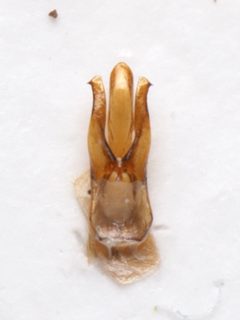
Distinguished from similar European Agriotes (A. sordidus, A. brevis) by pronotum : less densely punctured and more shiny between punctures. Larvae identified by pattern on abdominal segments: fine dense granules in belt-like regions on first 8 segments versus larger sparse granules elsewhere. Molecular identification of larvae is feasible. Larval growth stages can be determined by counting teeth on rather than body measurements.
Images
Habitat
Natural is grassland, from which crop fields are frequently invaded. In Austria, larvae most common at 300–500 m elevation in areas with 750 mm rainfall and low soil pH. In Croatia, associated with white clover, alfalfa, sugar beet, and barley fields. found on flower- of umbelliferous plants.
Distribution
Native to Europe: widespread in UK, France, Germany, southern Sweden, Austria, Hungary, Poland, Switzerland; absent from Finland and northern parts of Norway, Sweden, Russia. South to Morocco and Algeria. East to western Siberia, Kazakhstan, Mongolia, and parts of China. West Asia: Turkey, Syria, Iran. Introduced to eastern Canada (Nova Scotia, Prince Edward Island, New Brunswick, Quebec); single unconfirmed record from Indianapolis, USA.
Seasonality
active from April/May through July/August, with peak activity in late May and early June. Most active in afternoon and evening. Adults emerge from soil in spring after . Larvae feed when soil temperature exceeds 12°C; move deeper in soil during cold or dry conditions.
Diet
Larvae are , feeding on roots, seeds, and seedlings of various plants including Poaceae (true grasses) and Plantago (plantains). feed on grass leaves and pollen.
Life Cycle
laid in batches (~100 eggs total) 2–5 cm beneath soil surface; hatch after approximately two weeks. Larval development spans 2–4 years (occasionally longer), progressing through 7–8 growth stages (not equivalent to instars; up to 9 observed). Larvae may moult without growth when food is inadequate. occurs in late summer or early autumn; emerge 2–3 weeks later but remain in soil until following spring. Total (egg to egg) up to 5 years.
Behavior
are and more active in humid conditions during dry weather. Marked individuals typically move within restricted areas; maximum recorded 26 yards (23.8 m). Larvae move vertically through soil profile, descending to 1 m or more to avoid cold (<-6°C) or dry conditions. Can survive extended periods without feeding. Females exhibit searching for oviposition sites, preferring grassland or clover leys over arable land.
Ecological Role
Soil-dwelling decomposer and herbivore; significant agricultural pest. Larvae preyed upon by birds (rooks, crows, starlings), ground beetles, and parasitic insects. Subject to natural by fungal including Zoophthora elateridiphaga, spp., and Metarhizium spp.
Human Relevance
Major agricultural pest causing damage to cereals (maize, wheat, barley), potatoes, clover, alfalfa, sunflower, sugar beet, and peanut. Damage concentrated on germinating seeds and seedlings; in potatoes, larvae tunnel into tubers. Managed through crop , soil , monitoring, and using fungi. Formerly controlled with organochlorine (now banned); neonicotinoids and phenylpyrazoles used with mixed effectiveness.
Similar Taxa
- Agriotes sordidusEuropean with similar size and coloration; distinguished by pronotum more densely punctured and less shiny between punctures
- Agriotes brevisEuropean with similar appearance; distinguished by pronotum and punctation pattern
- Agriotes lineatusSimilar agricultural pest; uses different component (geranyl octanoate vs. geranyl butanoate); males more mobile and pheromone traps more effective
Sources and further reading
- BugGuide
- Wikipedia
- GBIF taxonomy match
- iNaturalist taxon
- NCBI Taxonomy
- Agriotes lineatus Archives - Entomology Today
- Beetle in a Haystack: Environmental DNA Reveals Invasive Pest Incursions
- A Method of distinguishing the larval Stages ofAgriotes sputator(L.) (Col., Elaterid.)
- SOME NOTES ON THE BIOLOGY OF THE CLICK BEETLES AGRIOTES OBSCURUS L. AND A. SPUTATOR L.
- Interaction of the wireworm species Agriotes obscurus , A. sputator and A. lineatus with a new granule formulation of Metarhizium brunneum
- THE BEHAVIOUR OF ADULT CLICK BEETLES OF THE GENUS AGRIOTES (A. OBSCURUS L., A. LINEATUS L., AND A. SPUTATOR L.)
- De novo transcriptome assembly and differential gene expression analysis in different developmental stages of Agriotes sputator (click beetle).