
Agriotes lineatus
Linnaeus, 1767
lined click beetle, wireworm
Agriotes lineatus, the lined click beetle, is a click beetle native to Europe and western Asia that has become in North America. are 7.5–11 mm long with brownish-black bodies and distinctive longitudinal stripes on the . The larvae, known as wireworms, are significant agricultural pests that attack roots, tubers, and seeds of crops including potatoes, maize, and strawberries. The species has a of approximately 3 years with up to 12 larval instars. Management relies on approaches including monitoring, crop , and .
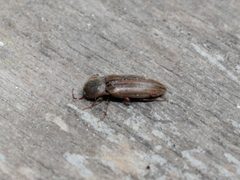
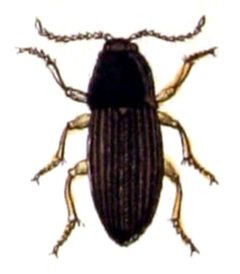
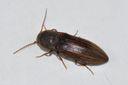
Pronunciation
How to pronounce Agriotes lineatus: //əˈɡraɪ.oʊ.tiːz lɪˈneɪ.ətəs//
These audio files are automatically generated. While they are not always 100% accurate, they are a good starting point.
Identification
Distinguished from similar Agriotes by the pronotum shape (as long as or slightly longer than wide) and more prominent longitudinal elytral stripes. Agriotes proximus is nearly identical morphologically and molecularly (>99% COI gene similarity), differing subtly in pronotum proportions and male genitalia (shorter , less sharp paramere hooks in A. lineatus). Larvae are indistinguishable from A. proximus; from A. obscurus larvae, they differ in having shorter, parallel-sided, subquadrate abdominal and specific mandibular and frontoclypeal angles. Molecular identification is feasible but challenging due to extreme similarity with A. proximus.
Images
Habitat
Native includes non-farmed areas and grasslands; feed on grass leaves. In agricultural settings, invades fields from adjacent grasslands. Larvae inhabit soil, preferring acidic, humus-rich soils with higher moisture. In central Europe, found at higher altitudes (400–500 m) with lower temperatures and higher winter precipitation.
Distribution
Native to most of Europe (absent from northern Norway, Sweden, Finland, and Russia), western Asia (Armenia, Azerbaijan, Georgia, Iran, Kazakhstan, Kyrgyzstan, Lebanon, Syria, Turkmenistan, Turkey), and the Near East. Introduced and in western Canada (British Columbia, Vancouver Island), Washington State (USA), and Atlantic Canada (Nova Scotia). Unconfirmed records exist for Massachusetts, eastern Russia, and Australia.
Seasonality
emerge in spring, with peak activity in late May and early June. laying begins in April, peaking in May and June in central Germany. Adults are active during afternoon and evening hours. Adults have a longer lifespan than some and overwinter.
Diet
feed on leaves of grasses. Larvae are , feeding on roots, seeds, and tubers of various plants including cereal crops (maize, wheat), potatoes, strawberries, and sugar beet.
Host Associations
- Solanum tuberosum - larval food plantpotato tubers attacked, major crop pest
- Zea mays - larval food plantroots and seeds attacked
- Triticum - larval food plantroots and seeds of wheat attacked
- Fragaria - larval food plantroots attacked
- Beta vulgaris - larval food plantsugar beet tubers attacked
- Poaceae - food plant feed on grass leaves in native grassland
Life Cycle
spans approximately 3 years in central Germany, likely longer further north. are laid in soil close to the surface in spring. Larvae emerge after approximately 3 weeks and pass through up to 12 instars over 2–3 years. occurs in soil and lasts 3–4 weeks. emerge in spring and can overwinter.
Behavior
exhibit clicking mechanism for righting themselves when overturned. Males are attracted to female (primarily geranyl octanoate with geranyl butanoate). In trap studies, A. lineatus males show higher activity and longer movement distances than A. obscurus; they frequently enter traps baited for other Agriotes unless both trap types are present. Adults prefer humid sites during dry weather and avoid hedgerows. Larvae are attracted to autoclaved millet substrate used in biocontrol .
Ecological Role
In native grasslands, function as herbivores on grasses and larvae as root-feeding /herbivores. In agricultural , larvae become significant pests through root and tuber feeding. Serves as for fungi including Metarhizium brunneum. -based monitoring indicates stability in heterogeneous landscapes.
Human Relevance
Major agricultural pest in Europe and regions, particularly damaging to potato, maize, and cereal production. Larval damage can affect more than 90% of potato tubers in heavily infested fields. Subject to including monitoring (10:1 geranyl octanoate:geranyl butanoate in Vernon Pitfall Traps), crop , timed tillage and irrigation to desiccate and larvae, and attempts with fungi and . Mass trapping and using pheromones have been attempted with limited success. Detected via environmental in green yard waste, indicating potential for spread through waste movement.
Similar Taxa
- Agriotes proximusExtremely similar , identical , indistinguishable larvae, >99% COI gene similarity; differs in pronotum slightly wider than long and male genitalia with thinner, sharper paramere hooks
- Agriotes obscurusSimilar pest; larvae differ in abdominal shape (longer in A. obscurus), mandibular tooth angle, and frontoclypeal angle
- Agriotes sputatorSimilar striped but stripes less prominent than in A. lineatus
- Agriotes modestusSimilar striped but stripes less prominent than in A. lineatus
More Details
Pheromone chemistry
Female contain primarily geranyl octanoate with trace amounts of geranyl butanoate; optimal field attraction uses 10 mg geranyl octanoate with 1 mg geranyl butanoate (10:1 ratio). Attraction range is short, with recapture rates halving at 10 m and again at 20 m from traps.
Taxonomic uncertainty
The separation of A. lineatus and A. proximus as distinct has been questioned due to minimal morphological, chemical, and genetic differences; some authorities treat them as or closely related cryptic species.
Invasion history
Introduced to western Canada around 1900, likely via ship ballast or agricultural materials; subsequently spread to Washington State and was detected in Nova Scotia by 1990s. Environmental detection in green yard waste demonstrates modern potential for human-mediated .
Sources and further reading
- BugGuide
- Wikipedia
- GBIF taxonomy match
- iNaturalist taxon
- NCBI Taxonomy
- Beetle in a Haystack: Environmental DNA Reveals Invasive Pest Incursions
- Who’s been sucking on my bee balm? Fourlined plant bug, Poecilocapsus lineatus — Bug of the Week
- Bee Balm Blues Courtesy of Fourlined plant bug, Poecilocapsus lineatus — Bug of the Week
- Arachnid Matriphagy: These Spider Mothers Literally Die for Their Young
- Complexity Untangled: For Plant Defenses, Pest Attack Order Matters
- Super Crop Challenge #15 | Beetles In The Bush
- Mass trapping wild Agriotes obscurus and Agriotes lineatus males with pheromone traps in a permanent grassland population reservoir
- Behavioural responses of Agriotes lineatus and Agriotes litigiosus wireworms to natural substances, synthetic volatile organic compounds and entomopathogenic fungi: Implications for sustainable pest management
- Interaction of the wireworm species Agriotes obscurus , A. sputator and A. lineatus with a new granule formulation of Metarhizium brunneum
- Mark–recapture of Agriotes obscurus and Agriotes lineatus with dense arrays of pheromone traps in an undisturbed grassland population reservoir
- Influence of climatic conditions on the distribution, abundance and activity of Agriotes lineatus L. adults in sex pheromone traps in Croatia
- Distribution of two European elaterids, Agriotes obscurus and A. lineatus in British Columbia: New records, and potential implications of their dispersal
- THE BEHAVIOUR OF ADULT CLICK BEETLES OF THE GENUS AGRIOTES (A. OBSCURUS L., A. LINEATUS L., AND A. SPUTATOR L.)
- Behavioral response of three subterranean pests (Agriotes lineatus, Diabrotica virgifera virgifera, Phyllopertha horticola) to the fungal volatile organic compounds 1-octen-3-ol and 3-octanone